Abstract
Inclusive growth has emerged as a fundamental objective of sustainable development, emphasizing equitable access to economic opportunities, social justice, and environmental sustainability. The United Nations Sustainable Development Goals (SDGs) provide a comprehensive global framework that integrates economic prosperity, environmental protection, and social well-being. However, achieving these goals requires more than government intervention; it demands collaborative efforts involving social innovation, community participation, academic institutions, civil society organizations, and the private sector. This paper presents a multidisciplinary analysis of the interrelationship between the SDGs, social innovation, and community participation in promoting inclusive growth. Drawing upon perspectives from economics, sociology, public administration, environmental studies, and development studies, the paper examines how innovative social practices and active citizen engagement contribute to addressing poverty, inequality, unemployment, climate change, and social exclusion. It further explores the role of participatory governance in improving policy effectiveness and ensuring that marginalized communities become active stakeholders in development processes. The study argues that sustainable development can only be realized through integrated governance models that combine institutional support with grassroots innovation and collective action. The findings highlight that collaborative partnerships, technological advancements, inclusive policymaking, and community empowerment significantly enhance the implementation of the SDGs. The paper concludes that multidisciplinary cooperation provides a robust pathway toward resilient societies capable of achieving sustainable and inclusive growth while ensuring that no individual or community is left behind.
- Sustainable Development Goals
- Inclusive Growth
- Social Innovation
- Community Participation
- Sustainable Development
- Participatory Governance
- Multidisciplinary Approach
Introduction#
The concept of sustainable development has undergone a remarkable transformation since the publication of the Brundtland Report in 1987, evolving from an environmental concern into a comprehensive framework encompassing economic development, social equity, and environmental conservation. In 2015, the United Nations adopted the 2030 Agenda for Sustainable Development, consisting of 17 Sustainable Development Goals (SDGs) that collectively seek to eradicate poverty, reduce inequality, promote quality education, ensure gender equality, foster decent work, combat climate change, and establish peaceful and inclusive societies. Unlike previous development agendas, the SDGs recognize the interconnected nature of global challenges and encourage multidisciplinary collaboration among governments, businesses, civil society organizations, academic institutions, and local communities. Inclusive growth has consequently become one of the central pillars of sustainable development because economic expansion alone cannot guarantee improved living standards unless its benefits are distributed equitably across all sections of society. Increasing disparities in income, access to education, healthcare, digital infrastructure, and employment opportunities continue to undermine sustainable development efforts in both developed and developing countries. Consequently, scholars and policymakers increasingly acknowledge that achieving inclusive growth requires innovative institutional mechanisms and meaningful community engagement that extend beyond conventional economic policies.
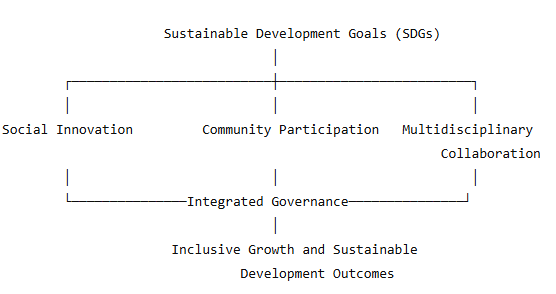
Figure: Conceptual Background
Within this context, social innovation and community participation have emerged as powerful instruments for accelerating the implementation of the Sustainable Development Goals. Social innovation refers to the development of new ideas, services, institutional arrangements, or collaborative practices that address societal challenges more effectively than traditional approaches while simultaneously creating social value. Community participation complements these innovations by ensuring that citizens actively contribute to identifying local needs, designing interventions, implementing development programmes, and monitoring outcomes. Together, these approaches strengthen democratic governance, improve accountability, enhance resource utilization, and foster social cohesion. A multidisciplinary perspective is particularly valuable because sustainable development intersects numerous academic disciplines, including economics, sociology, environmental science, political science, public administration, education, and technology. Integrating knowledge from these disciplines enables researchers and policymakers to better understand the complex relationships between economic growth, social inclusion, environmental sustainability, and institutional effectiveness. This paper therefore examines the dynamic relationship among Sustainable Development Goals, social innovation, and community participation in achieving inclusive growth. It explores how collaborative governance, grassroots innovation, technological advancement, and participatory decision-making contribute to sustainable development outcomes while identifying the challenges that continue to hinder effective implementation. Ultimately, the study argues that multidisciplinary cooperation, supported by inclusive policies and empowered communities, represents the most effective strategy for achieving equitable, resilient, and sustainable societies in accordance with the aspirations of the 2030 Agenda.
Sustainable Development Goals as the Foundation of Inclusive Growth#
The Sustainable Development Goals (SDGs) constitute a comprehensive global framework that seeks to balance economic progress, social equity, and environmental sustainability while ensuring that development benefits all sections of society. Adopted by the United Nations in 2015, the 17 SDGs provide a universal roadmap for addressing interconnected global challenges such as poverty, hunger, inequality, climate change, health disparities, quality education, gender discrimination, and environmental degradation. Unlike the Millennium Development Goals, which primarily focused on developing countries, the SDGs recognize that sustainable development is a shared responsibility requiring collective action from governments, international organizations, private enterprises, academic institutions, civil society organizations, and local communities. At the heart of the SDGs lies the principle of **"leaving no one behind,"** emphasizing that development must be inclusive, equitable, and accessible to vulnerable and marginalized populations. Inclusive growth extends beyond increasing gross domestic product (GDP); it focuses on creating opportunities that enable individuals to participate meaningfully in economic activities while ensuring equitable distribution of resources, income, education, healthcare, and employment opportunities. Consequently, SDGs such as No Poverty (SDG 1), Zero Hunger (SDG 2), Good Health and Well-being (SDG 3), Quality Education (SDG 4), Gender Equality (SDG 5), Decent Work and Economic Growth (SDG 8), Reduced Inequalities (SDG 10), Sustainable Cities and Communities (SDG 11), Climate Action (SDG 13), and Partnerships for the Goals (SDG 17) collectively establish the foundation for inclusive and sustainable development. The multidimensional nature of these goals demonstrates that economic prosperity cannot be sustained without environmental conservation, social justice, institutional accountability, and active citizen participation. Research indicates that countries investing simultaneously in education, healthcare, digital infrastructure, social protection systems, and environmental sustainability experience higher levels of human development and long-term economic resilience. Furthermore, technological innovation has become a significant enabler of SDG implementation by expanding access to digital financial services, online education, telemedicine, precision agriculture, renewable energy technologies, and data-driven governance systems. However, technological progress alone is insufficient unless accompanied by inclusive policies that bridge the digital divide and promote equal opportunities for disadvantaged communities. Governments play a central role in integrating SDGs into national development plans through evidence-based policymaking, institutional reforms, public investment, and transparent governance mechanisms. At the same time, the private sector contributes through responsible business practices, sustainable investments, corporate social responsibility initiatives, and green innovation that align commercial objectives with societal well-being. Universities and research institutions support SDG implementation by generating interdisciplinary knowledge, developing innovative technologies, and evaluating policy effectiveness, while civil society organizations strengthen public awareness, advocacy, and community mobilization. Despite notable progress, numerous challenges continue to hinder effective implementation of the SDGs, including financial constraints, weak institutional capacity, political instability, environmental degradation, unequal access to technology, and socioeconomic inequalities exacerbated by global crises such as the COVID-19 pandemic and climate-related disasters. These challenges highlight the necessity of adopting multidisciplinary approaches that combine economic planning, social innovation, environmental management, participatory governance, and international cooperation. Achieving inclusive growth therefore requires coordinated action across sectors, continuous policy adaptation, and meaningful stakeholder engagement. By integrating sustainable economic development with social inclusion and environmental stewardship, the SDGs provide an indispensable framework for creating resilient societies capable of addressing present and future developmental challenges while promoting prosperity, equality, and dignity for all citizens.
Community Participation and Multidisciplinary Collaboration in Achieving Inclusive Growth#
Community participation represents one of the most significant pillars of sustainable development because it ensures that development initiatives are designed, implemented, and evaluated with the active involvement of the people they are intended to benefit. The principle of participatory development recognizes communities not merely as recipients of government assistance but as equal partners possessing valuable local knowledge, cultural understanding, and practical experience. Within the framework of the Sustainable Development Goals (SDGs), community participation strengthens democratic governance, enhances transparency and accountability, improves resource allocation, and increases the long-term sustainability of development interventions. Inclusive growth cannot be achieved solely through top-down policymaking; rather, it requires continuous dialogue among governments, local authorities, civil society organizations, academic institutions, private enterprises, and citizens. Such collaboration promotes trust, shared responsibility, and collective ownership of development programmes while ensuring that the voices of marginalized populations—including women, persons with disabilities, indigenous communities, rural populations, older persons, and economically disadvantaged groups—are adequately represented in decision-making processes. Community participation contributes directly to several SDGs, including poverty reduction, quality education, gender equality, sustainable cities, climate action, and strong institutions, by fostering locally relevant solutions that reflect the priorities and aspirations of diverse populations. Simultaneously, multidisciplinary collaboration enhances the effectiveness of participatory development by integrating knowledge from economics, sociology, public administration, environmental science, education, public health, engineering, and information technology.
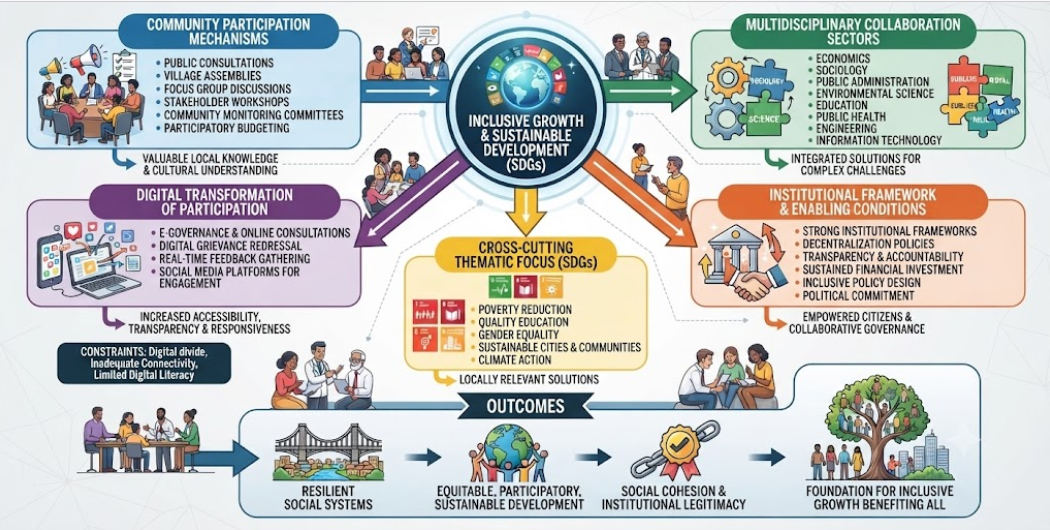
Figure: Community Participation and Multidisciplinary Collaboration in Achieving Inclusive Growth
This interdisciplinary approach enables policymakers and practitioners to address complex development challenges from multiple perspectives rather than relying on isolated sectoral interventions. For example, improving rural livelihoods may require coordinated efforts involving agricultural experts, economists, environmental scientists, healthcare professionals, educators, financial institutions, and local governance bodies. Likewise, urban sustainability initiatives benefit from collaboration among urban planners, environmental engineers, public administrators, community organizations, and technology specialists to develop resilient infrastructure, affordable housing, efficient transportation systems, and sustainable waste management practices. The rapid expansion of digital technologies has further transformed community participation by facilitating e-governance, online public consultations, digital grievance redressal systems, participatory budgeting, and social media platforms that encourage citizen engagement in public affairs. These technologies increase accessibility, transparency, and responsiveness while enabling governments to gather real-time feedback and make evidence-based policy decisions. Nevertheless, digital participation remains constrained in many developing regions by inadequate internet connectivity, limited digital literacy, socioeconomic inequalities, and unequal access to technological resources. Consequently, governments must complement digital engagement with traditional participatory mechanisms such as public consultations, village assemblies, focus group discussions, stakeholder workshops, and community monitoring committees. Capacity-building initiatives are equally important for empowering citizens to participate meaningfully in governance processes through leadership development, civic education, technical training, and awareness campaigns. Strong institutional frameworks that promote decentralization, transparency, accountability, and collaborative governance further enhance the effectiveness of community participation by encouraging partnerships between public institutions and local stakeholders. Moreover, successful participatory development depends on sustained financial investment, inclusive policy design, political commitment, and continuous evaluation of programme outcomes. Ultimately, community participation and multidisciplinary collaboration create resilient social systems capable of responding effectively to emerging economic, environmental, and social challenges. By combining scientific knowledge with local expertise and fostering partnerships across sectors, societies can accelerate progress toward the Sustainable Development Goals while ensuring that development remains equitable, participatory, and sustainable. Such collaborative approaches strengthen social cohesion, improve institutional legitimacy, and establish a foundation for inclusive growth that benefits present and future generations.
Conclusion#
The pursuit of sustainable development has become one of the defining priorities of the twenty-first century as nations seek to address interconnected economic, social, and environmental challenges while ensuring equitable opportunities for all citizens. This paper has demonstrated that the Sustainable Development Goals (SDGs) provide a comprehensive global framework that extends beyond economic growth by integrating social inclusion, environmental sustainability, and institutional effectiveness into a unified development agenda. Achieving inclusive growth requires more than macroeconomic policies or financial investments; it demands collaborative action involving governments, businesses, academic institutions, civil society organizations, and local communities. The multidisciplinary perspective adopted throughout this study highlights that sustainable development cannot be accomplished through isolated interventions because issues such as poverty, inequality, climate change, unemployment, public health, and educational disparities are deeply interconnected. Consequently, effective solutions require the integration of knowledge and expertise from economics, sociology, political science, environmental studies, public administration, technology, education, and public health. Such interdisciplinary collaboration enables policymakers and practitioners to design holistic strategies that simultaneously address multiple dimensions of development while maximizing social impact.
The analysis further emphasizes that social innovation serves as a powerful catalyst for translating the aspirations of the SDGs into practical and sustainable outcomes. Innovative governance models, digital technologies, social enterprises, community-based initiatives, and collaborative partnerships have demonstrated significant potential for improving access to education, healthcare, financial services, clean energy, and employment opportunities, particularly for marginalized populations. However, innovation alone cannot guarantee inclusive development unless it is supported by appropriate institutional frameworks, transparent governance, adequate financial resources, and policies that promote equity and social justice. Equally important is the active participation of communities in identifying development priorities, implementing programmes, monitoring outcomes, and evaluating policy effectiveness. Community participation strengthens democratic governance, enhances accountability, builds trust among stakeholders, and ensures that development interventions are responsive to local needs and cultural contexts. When citizens become active partners rather than passive beneficiaries, development programmes achieve greater legitimacy, efficiency, and long-term sustainability.
Despite significant global progress toward achieving the SDGs, considerable challenges remain. Persistent poverty, widening socioeconomic inequalities, climate change, biodiversity loss, political instability, technological disparities, and limited institutional capacity continue to hinder sustainable development efforts across many regions. These challenges underscore the importance of strengthening international cooperation, promoting inclusive governance, expanding access to digital technologies, and increasing investments in education, research, innovation, and institutional capacity-building. Future development strategies should prioritize evidence-based policymaking, interdisciplinary research, public-private partnerships, and participatory governance mechanisms that empower communities to contribute meaningfully to decision-making processes. Furthermore, continuous monitoring and evaluation using measurable indicators are essential for assessing progress and adapting policies to changing socioeconomic and environmental conditions.
In conclusion, the Sustainable Development Goals, social innovation, and community participation are mutually reinforcing components of an integrated development framework that supports inclusive growth. Their successful implementation depends upon coordinated efforts across multiple disciplines, sectors, and governance levels. By fostering innovation, empowering communities, strengthening institutions, and promoting collaborative partnerships, societies can build resilient economies, reduce inequalities, protect natural resources, and improve the quality of life for present and future generations. Ultimately, inclusive growth is not merely an economic objective but a comprehensive vision of development that recognizes human dignity, social justice, environmental stewardship, and shared responsibility as the foundations of sustainable and prosperous societies.
References#
- Avelino, F., Wittmayer, J. M., Pel, B., Weaver, P., Dumitru, A., Haxeltine, A., ... & O'Riordan, T. (2019). Transformative social innovation and (dis)empowerment. Technological Forecasting and Social Change, 145, 195–206. https://doi.org/10.1016/j.techfore.2017.05.002
- Bocken, N. M. P., Short, S. W., Rana, P., & Evans, S. (2019). A literature review and practice review to develop sustainable business model archetypes. Journal of Cleaner Production, 65, 42–56.
- Gupta, J., Vegelin, C., & others. (2020). Sustainable development goals and inclusive development. International Environmental Agreements, 20(2), 193–210.
- Kolk, A., Kourula, A., & Pisani, N. (2017). Multinational enterprises and the Sustainable Development Goals. Journal of World Business, 52(1), 23–28.
- Leal Filho, W., Azul, A. M., Brandli, L., Özuyar, P. G., & Wall, T. (Eds.). (2021). The Sustainable Development Goals: Theory and practice. Springer.
- Moulaert, F., MacCallum, D., Mehmood, A., & Hamdouch, A. (Eds.). (2013). The international handbook on social innovation. Edward Elgar Publishing.
- Organisation for Economic Co-operation and Development. (2020). The territorial impact of COVID-19: Managing the crisis across levels of government. OECD Publishing.
- Ostrom, E. (1990). Governing the commons: The evolution of institutions for collective action. Cambridge University Press.
- Sachs, J. D., Kroll, C., Lafortune, G., Fuller, G., & Woelm, F. (2024). Sustainable Development Report 2024. Sustainable Development Solutions Network.
- Sen, A. (1999). Development as freedom. Oxford University Press.
- Smith, A., Fressoli, M., & Thomas, H. (2014). Grassroots innovation movements. Journal of Cleaner Production, 63, 114–124.
- United Nations. (2015). Transforming our world: The 2030 Agenda for Sustainable Development. United Nations.
- United Nations Development Programme. (2023). Human Development Report 2023/2024. UNDP.
- United Nations Educational, Scientific and Cultural Organization. (2021). Reimagining our futures together: A new social contract for education. UNESCO.
- United Nations Environment Programme. (2024). Global Environment Outlook. UNEP.
- World Bank. (2024). World Development Report 2024: The middle-income trap. World Bank.
- World Economic Forum. (2024). The Global Risks Report 2024. World Economic Forum.
- Yunus, M. (2017). A world of three zeros. PublicAffairs.
- Zaheer, H., Breyer, C., & Farfan, J. (2021). Renewable energy transition and sustainable development goals. Renewable and Sustainable Energy Reviews, 150, 111–126.
- Ziegler, R. (2019). Social innovation as a collaborative concept. Edward Elgar Publishing.
IJLSCL#
International Journal of Legal Studies and Contemporary Law
Netherland
ISSN: 3117-5198 (Print)
ISSN: 3117-5201 (Online)