Abstract
Artificial Intelligence (AI) has emerged as one of the most transformative technologies of the twenty-first century, significantly influencing the creation, distribution, and commercialization of creative works across literature, music, visual arts, software, film, journalism, and digital content industries. Advanced generative AI systems are now capable of producing paintings, musical compositions, novels, poems, computer programs, architectural designs, and multimedia content with minimal human intervention. While these technological advancements have expanded opportunities for innovation and creativity, they have simultaneously challenged the traditional foundations of intellectual property law. Existing copyright, patent, trademark, and related rights frameworks were developed on the assumption that human creators are the primary authors and inventors of intellectual works. AI-generated creations therefore raise complex legal questions concerning authorship, ownership, originality, inventorship, infringement, licensing, liability, fair use, moral rights, and commercial exploitation.The absence of internationally harmonized legal standards has resulted in varying regulatory approaches across jurisdictions regarding the protection of AI-generated works. Courts, policymakers, and intellectual property offices increasingly face disputes concerning whether AI-generated content qualifies for copyright protection, whether developers or users should own AI-created outputs, and how existing intellectual property laws should accommodate rapidly evolving technologies. Furthermore, the use of copyrighted materials to train AI models has intensified debates concerning data usage, fair dealing, transparency, and creators' rights. This chapter critically examines the legal challenges associated with regulating AI-generated creative works by exploring the interaction between artificial intelligence and intellectual property law, comparative legal developments, emerging regulatory frameworks, and future policy directions. It concludes that balanced legal reforms are essential to encourage technological innovation while protecting human creativity, economic incentives, and the fundamental objectives of intellectual property systems.
- Artificial Intelligence
- Intellectual Property Rights
- Copyright
- AI-Generated Works
- Authorship
- Creativity
- Patent Law
- Copyright Infringement
- Generative AI
- Digital Innovation
Introduction#
Artificial Intelligence has rapidly transformed the creative landscape by enabling machines to generate original-looking content that was previously considered the exclusive domain of human creativity. Recent advances in machine learning, deep learning, neural networks, and generative AI technologies have enabled sophisticated systems to produce literary works, paintings, music, films, software code, architectural designs, fashion designs, scientific research, and multimedia content with remarkable speed and quality. Generative AI platforms are increasingly utilized by artists, businesses, educational institutions, software developers, publishers, and entertainment industries to enhance productivity, reduce production costs, and expand creative possibilities. Consequently, AI-generated creative works have become an integral component of the digital economy and the knowledge-based society.
Despite these technological advancements, AI-generated creativity presents profound legal challenges for intellectual property law. Traditional intellectual property systems were designed to reward and protect human creativity by granting exclusive rights to authors, inventors, performers, designers, and innovators. Copyright law, in particular, is founded upon the principle that original creative expression originates from human intellectual effort. Patent law similarly recognizes human inventors who develop novel, inventive, and industrially applicable inventions. However, AI systems increasingly operate with substantial autonomy, generating creative outputs that may involve limited or no direct human creative contribution. This development challenges long-established legal doctrines concerning authorship, originality, ownership, inventorship, moral rights, and economic rights.
One of the most debated legal issues concerns whether AI-generated works should receive copyright protection. If copyright protection requires human authorship, purely autonomous AI-generated works may fall outside existing legal frameworks. Conversely, denying protection may discourage investment in AI technologies and reduce incentives for technological innovation. Determining whether copyright should belong to AI developers, users, data providers, employers, or remain within the public domain continues to generate extensive legal and academic debate.
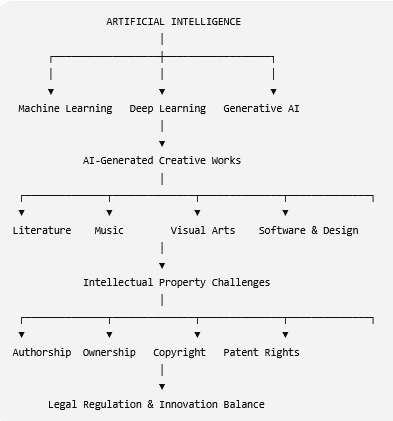
Figure: AI-Generated Creative Works and Intellectual Property Framework
Another important issue concerns the use of copyrighted materials for training AI systems. Generative AI models are developed using massive datasets that frequently include books, artworks, music, photographs, films, software, and online content protected by copyright. This practice raises questions regarding copyright infringement, fair use, licensing obligations, transparency, and compensation for original creators. Courts worldwide are increasingly confronted with litigation concerning unauthorized use of copyrighted works in AI training processes. Patent law also faces significant challenges arising from AI-assisted inventions. Questions concerning whether AI systems may qualify as inventors, how inventive step should be evaluated when AI contributes substantially to innovation, and who should own AI-assisted inventions remain unresolved in many jurisdictions. As governments and international organizations seek to regulate artificial intelligence responsibly, intellectual property law must evolve to accommodate technological innovation without undermining the incentives that encourage human creativity, artistic expression, scientific research, and commercial innovation. This chapter examines the legal status of AI-generated creative works by analyzing authorship, ownership, copyright protection, patent issues, comparative legal developments, regulatory challenges, and future prospects for intellectual property law in the age of artificial intelligence.
Legal Framework Governing AI-Generated Creative Works and Intellectual Property Rights#
The legal framework governing Artificial Intelligence (AI)-generated creative works is primarily derived from traditional intellectual property (IP) laws, including copyright law, patent law, trademark law, industrial design law, and international intellectual property treaties. These legal systems were developed to encourage innovation and reward human creativity by granting exclusive rights to creators, inventors, and innovators. However, the rapid evolution of generative AI technologies has exposed significant limitations within these traditional legal frameworks because they were drafted on the assumption that intellectual creations originate from human intellect and creativity. AI systems are now capable of autonomously producing literary works, paintings, music, films, software code, architectural designs, scientific research, and other forms of creative expression with minimal or no direct human intervention. Consequently, existing intellectual property doctrines concerning authorship, originality, ownership, inventorship, and infringement require careful reinterpretation to address these technological developments. Copyright law remains the principal legal mechanism governing creative works. Under most national copyright statutes and international agreements, copyright protection is granted to original literary, artistic, musical, dramatic, and audiovisual works created through human intellectual effort. The fundamental requirements for copyright protection generally include originality, fixation in a tangible medium, and identifiable authorship. The concept of originality traditionally requires that a work originate from the author's independent intellectual creation involving creative judgment and personal expression. Since AI systems lack legal personality and independent legal rights, uncertainty arises when creative outputs are generated without substantial human creative contribution. Many legal scholars argue that fully autonomous AI-generated works do not satisfy existing human authorship requirements and therefore fall outside conventional copyright protection. Others contend that copyright ownership should instead belong to the individual who designed, programmed, trained, or directed the AI system responsible for generating the work. A third perspective advocates treating purely autonomous AI-generated outputs as part of the public domain to ensure unrestricted public access while avoiding legal uncertainty regarding ownership. These competing approaches continue to influence legislative reform and judicial interpretation across multiple jurisdictions. Patent law presents similarly complex legal questions. Traditional patent systems require inventions to be novel, involve an inventive step, possess industrial applicability, and identify a human inventor responsible for the inventive concept. As AI increasingly contributes to scientific discovery, pharmaceutical research, engineering, biotechnology, software development, and industrial innovation, determining inventorship has become increasingly difficult. AI systems may generate innovative technical solutions independently after analyzing vast datasets and identifying patterns beyond human capability. Several patent applications naming AI systems as inventors have been rejected by patent offices because existing patent statutes recognize only natural persons as inventors. Nevertheless, AI-assisted inventions continue to receive patent protection where human researchers maintain sufficient intellectual contribution throughout the inventive process. Future patent law reforms may clarify standards governing AI-assisted innovation while preserving incentives for technological research and commercial development. Trademark law has been comparatively less affected because trademark protection primarily concerns commercial identification rather than creative authorship. Nevertheless, AI increasingly assists businesses in developing brand names, logos, advertising materials, product packaging, marketing strategies, and consumer engagement systems. Questions may arise concerning ownership of AI-generated branding materials, potential infringement resulting from algorithmically generated trademarks, and liability for consumer confusion created through automated marketing technologies. Industrial design protection similarly extends to AI-generated product designs, fashion designs, architectural models, and digital interfaces where originality and commercial application satisfy statutory requirements. Beyond traditional intellectual property doctrines, licensing agreements play an increasingly important role in regulating AI-generated creative works. Developers of generative AI systems frequently establish contractual terms governing ownership, commercial exploitation, permissible use, redistribution, modification, and liability relating to AI-generated outputs. These contractual arrangements supplement statutory intellectual property protections by defining rights and responsibilities among AI developers, commercial users, content creators, and consumers. Another major legal issue concerns the use of copyrighted materials to train AI models. Generative AI systems require extensive datasets containing books, artworks, music, photographs, films, software, websites, and other copyrighted materials to develop machine learning capabilities. This practice raises fundamental questions concerning copyright infringement, fair use, fair dealing, licensing obligations, transparency, and compensation for original creators. Some jurisdictions interpret AI training as falling within copyright exceptions for research or transformative use, while others emphasize the necessity of obtaining authorization from copyright holders before using protected works within training datasets. Courts continue evaluating whether AI training constitutes permissible technological innovation or unauthorized reproduction of copyrighted content. International legal instruments provide additional guidance for regulating AI-generated creative works. Agreements administered by international intellectual property organizations establish minimum standards for copyright, patents, trademarks, and related rights while encouraging harmonization among national legal systems. However, these international frameworks were developed before the emergence of advanced generative AI technologies and therefore provide limited direct guidance regarding autonomous machine-generated creativity. Consequently, governments worldwide are considering legislative reforms specifically addressing AI authorship, AI-generated content, algorithmic transparency, data governance, licensing mechanisms, and digital innovation. Ultimately, the evolving legal framework governing AI-generated creative works seeks to achieve an appropriate balance between encouraging technological advancement and preserving the fundamental objectives of intellectual property law. Effective regulation should continue protecting human creativity, promoting innovation, ensuring legal certainty, facilitating commercial investment, safeguarding creators' rights, and fostering responsible development of artificial intelligence while adapting established legal principles to the realities of an increasingly AI-driven creative economy.
Regulatory Challenges, Comparative Legal Approaches, and Judicial Responses#
The rapid expansion of generative Artificial Intelligence (AI) has exposed significant regulatory gaps within existing intellectual property systems, compelling legislators, courts, and policymakers worldwide to reconsider traditional legal doctrines governing creativity, ownership, innovation, and copyright protection. While AI technologies have revolutionized creative industries by producing text, music, artwork, software, films, and other digital content with remarkable speed and sophistication, they have simultaneously generated unprecedented legal challenges concerning authorship, ownership, infringement, liability, transparency, and international regulatory harmonization. One of the most significant regulatory challenges concerns determining authorship and ownership of AI-generated creative works. Traditional copyright law recognizes authors as natural persons who exercise intellectual creativity and independent judgment in producing original works. Since AI systems lack legal personality and cannot hold legal rights or obligations, uncertainty arises regarding who should own copyright in content generated primarily through autonomous machine learning. Several competing legal theories have emerged. One approach attributes ownership to the human user who provides prompts or instructions to the AI system, arguing that meaningful creative input remains essential to the final output. Another approach recognizes the AI developer or software provider as the rightful owner because the underlying algorithms and training architecture enable the creative process. A third perspective suggests that works generated entirely without substantial human creative contribution should enter the public domain, ensuring unrestricted public access while avoiding uncertainty concerning ownership rights. The absence of international consensus continues to create legal inconsistency and commercial uncertainty across jurisdictions. A second major challenge concerns the use of copyrighted works for AI training. Modern generative AI models require enormous datasets containing books, photographs, artworks, films, music, research papers, software code, websites, and other copyrighted materials to develop sophisticated learning capabilities. Copyright holders increasingly argue that the unauthorized use of their protected works during AI training constitutes copyright infringement because entire works are copied, processed, and analyzed without permission or compensation. Conversely, AI developers often maintain that machine learning constitutes a transformative technological process comparable to research, indexing, or text-and-data mining, which may fall within statutory exceptions such as fair use or fair dealing depending upon the applicable legal system. This debate has become one of the most significant intellectual property issues of the digital era, prompting governments to consider whether compulsory licensing systems, collective rights management, or statutory exceptions should regulate AI training datasets while balancing technological innovation with creators' economic interests. Judicial responses to AI-generated creative works remain cautious and generally adhere to established principles of intellectual property law. Courts have consistently emphasized that copyright protection requires meaningful human authorship and creative contribution. Where AI merely functions as a sophisticated tool assisting human creativity, courts are more likely to recognize copyright protection because the human user exercises creative judgment over the final work. Conversely, purely autonomous AI-generated outputs created without substantial human intellectual contribution frequently fall outside conventional copyright protection under existing legal standards. Judicial decisions also increasingly distinguish between AI-assisted creativity and AI-generated creativity, recognizing that human involvement remains central to determining copyright ownership and originality. Patent law has encountered similar judicial challenges concerning AI-assisted inventions. Patent offices and courts generally continue requiring human inventorship, rejecting applications that identify AI systems as inventors while accepting inventions in which humans maintain significant intellectual control over the inventive process. These decisions reinforce the principle that legal rights and responsibilities remain attached to natural persons despite increasing technological sophistication. Comparative legal approaches demonstrate considerable variation among jurisdictions. Some countries have adopted technology-neutral interpretations of existing intellectual property legislation, allowing traditional legal principles to evolve through judicial interpretation rather than immediate statutory reform. Other jurisdictions have initiated legislative reviews examining whether copyright statutes should explicitly address AI-generated works, define standards for human authorship, regulate AI training datasets, and establish liability rules governing developers, users, and commercial operators. Several governments have also introduced ethical AI frameworks emphasizing transparency, accountability, explainability, fairness, and responsible innovation alongside intellectual property protection. International organizations increasingly recognize that fragmented national approaches may impede global innovation and cross-border digital commerce. Consequently, efforts are underway to encourage harmonized legal standards concerning AI-generated content, copyright exceptions, licensing mechanisms, digital rights management, cross-border enforcement, and ethical governance. Consumer protection constitutes another important regulatory concern because AI-generated creative works may inadvertently reproduce copyrighted content, generate misleading information, or create uncertainty regarding authenticity and provenance. Legislators may therefore require AI developers to disclose the use of generative technologies, implement content traceability mechanisms, maintain records of training datasets where appropriate, and adopt safeguards preventing unlawful reproduction of protected works. Transparency obligations may further strengthen public confidence while assisting copyright owners in identifying potential infringement. Another emerging issue concerns moral rights, including the rights of attribution and integrity traditionally granted to human authors. Since AI lacks legal personality and moral interests, determining whether users, developers, or commissioning organizations should exercise moral rights over AI-generated works presents additional legal complexity. Environmental, cultural, and ethical considerations further influence regulatory debates, particularly regarding the preservation of human creativity, artistic diversity, and cultural heritage in increasingly automated creative industries. Looking forward, regulatory systems must achieve a balanced approach that encourages innovation without undermining the fundamental objectives of intellectual property law. Effective legal frameworks should provide certainty regarding ownership, establish fair licensing mechanisms for AI training, strengthen transparency and accountability, protect creators' legitimate economic interests, promote responsible technological development, and facilitate international cooperation. Ultimately, the regulation of AI-generated creative works will require continuous legislative adaptation, informed judicial interpretation, interdisciplinary collaboration, and global policy coordination to ensure that artificial intelligence enhances rather than diminishes human creativity, innovation, and the long-term integrity of intellectual property systems.
Future Prospects and Emerging Legal Developments in Regulating AI-Generated Creative Works and Intellectual Property Rights#
The future regulation of Artificial Intelligence (AI)-generated creative works will largely depend upon the ability of legal systems to reconcile rapid technological innovation with the fundamental objectives of intellectual property law, namely encouraging creativity, rewarding innovation, protecting economic interests, and promoting public access to knowledge. As generative AI technologies continue evolving at an unprecedented pace, governments, courts, international organizations, and intellectual property offices will increasingly be required to develop adaptive legal frameworks capable of addressing novel issues concerning authorship, ownership, originality, liability, licensing, transparency, and cross-border enforcement. One of the most significant future developments will involve the establishment of comprehensive statutory frameworks specifically governing AI-generated creative works. Rather than relying exclusively on traditional copyright doctrines designed for human creators, future legislation is expected to clarify the legal status of AI-assisted and AI-generated works, define the degree of human involvement necessary for copyright protection, establish ownership rules for commercial AI outputs, and specify the respective legal responsibilities of AI developers, users, employers, and platform providers. Such reforms will reduce legal uncertainty while encouraging investment in responsible AI innovation. Another important development concerns international harmonization of intellectual property law. Since AI technologies operate across national borders and digital content is distributed globally, inconsistent national regulations create legal uncertainty for creators, businesses, technology companies, publishers, and consumers. International organizations are therefore expected to facilitate greater cooperation among states in developing common principles governing AI-generated works, copyright exceptions, licensing mechanisms, digital rights management, patent eligibility, and cross-border enforcement. Harmonized legal standards will improve commercial certainty while supporting innovation within the global digital economy. Licensing models are also expected to evolve significantly. Future legal systems may encourage collective licensing arrangements, extended collective management organizations, compulsory licensing mechanisms, or standardized commercial agreements permitting AI developers to access copyrighted materials for machine learning while ensuring fair remuneration for copyright owners. Such licensing systems could reduce litigation, promote transparency, and establish equitable compensation mechanisms that balance technological advancement with creators' legitimate economic interests. Artificial intelligence itself will increasingly assist in intellectual property administration. AI-powered systems may automate patent examinations, trademark searches, copyright registration, infringement detection, prior-art analysis, licensing management, royalty distribution, and digital rights enforcement. While these technological applications improve administrative efficiency, they also require legal safeguards ensuring algorithmic transparency, procedural fairness, accountability, human oversight, and judicial review of automated administrative decisions. Governments will therefore need to establish ethical governance principles regulating AI use within intellectual property institutions themselves. Another emerging area involves transparency obligations for generative AI systems. Future regulations may require AI developers to disclose the use of copyrighted materials in training datasets, maintain records regarding data sources, identify AI-generated content through digital watermarking or metadata, and provide mechanisms enabling copyright owners to exercise control over the use of their works in machine learning processes. Enhanced transparency would strengthen public trust, facilitate copyright enforcement, and reduce disputes concerning unauthorized use of protected materials.
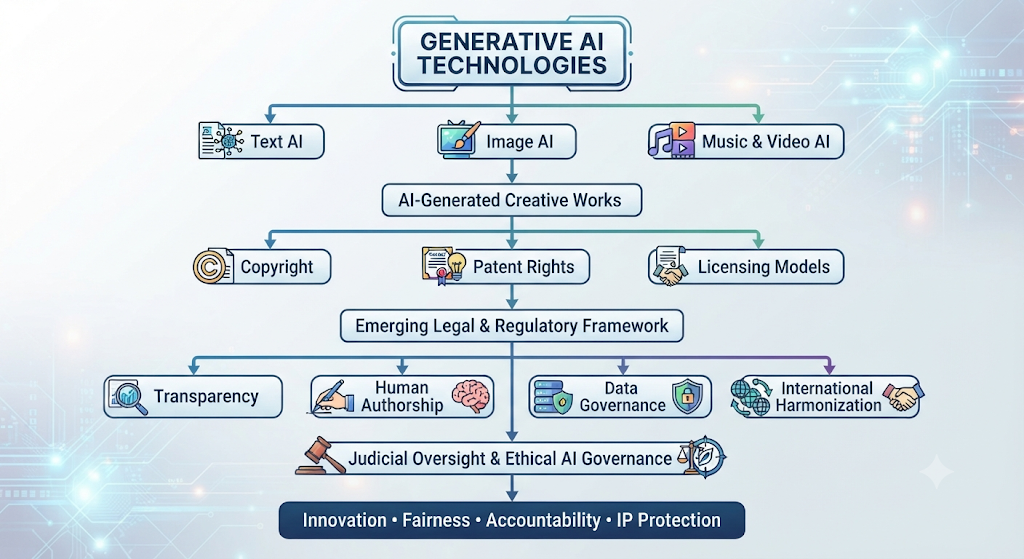
Figure: Future Prospects and Emerging Legal Developments in Regulating AI-Generated Creative Works and Intellectual Property Rights
Data governance will also become increasingly significant because generative AI systems depend upon massive datasets containing literary works, artistic creations, music, software code, audiovisual materials, and scientific publications. Legislators are expected to introduce clearer legal standards governing lawful data acquisition, privacy protection, consent mechanisms, text-and-data mining exceptions, and responsible data management to ensure that technological innovation remains consistent with copyright law, personal data protection, and ethical principles. Judicial institutions will continue playing an essential role in shaping AI-related intellectual property law through progressive interpretation of existing legal doctrines. Courts are expected to distinguish more precisely between AI-assisted creativity, in which humans exercise meaningful creative judgment, and fully autonomous AI-generated outputs, which may require distinct legal treatment. Judicial decisions will likely influence future legislative reforms by clarifying standards of originality, human authorship, inventive contribution, infringement, and commercial liability. Ethical considerations will increasingly influence future legal regulation. Policymakers must ensure that AI technologies complement rather than replace human creativity, preserve cultural diversity, protect artistic integrity, encourage fair competition, and prevent excessive concentration of technological power within a limited number of AI developers or digital platforms. Educational institutions, creative industries, legal professionals, and technology companies will also play important roles in promoting responsible AI practices, digital literacy, and awareness regarding intellectual property compliance. Emerging technologies such as blockchain, decentralized digital identities, smart contracts, non-fungible tokens (NFTs), and AI-generated digital assets may further transform intellectual property management by improving ownership verification, licensing automation, royalty distribution, and digital rights enforcement. These innovations have the potential to strengthen transparency and reduce transactional complexity while creating new legal questions requiring continuous legislative adaptation. Ultimately, the future regulation of AI-generated creative works should not seek to impede technological progress but rather to establish a balanced legal environment in which innovation flourishes alongside effective protection of human creativity, economic incentives, cultural development, and public interest. Through adaptive legislation, responsible judicial interpretation, international cooperation, ethical governance, and transparent regulatory mechanisms, legal systems can ensure that artificial intelligence becomes a powerful tool supporting creative expression while preserving the enduring objectives of intellectual property law in the digital age.
4. Future Prospects and Emerging Legal Developments in Regulating AI-Generated Creative Works and Intellectual Property Rights 4. Future Prospects and Emerging Legal Developments in Regulating AI-Generated Creative Works and Intellectual Property Rights 4. Future Prospects and Emerging Legal Developments in Regulating AI-Generated Creative Works and Intellectual Property Rights 4. Future Prospects and Emerging Legal Developments in Regulating AI-Generated Creative Works and Intellectual Property Rights 4. Future Prospects and Emerging Legal Developments in Regulating AI-Generated Creative Works and Intellectual Property Rights Top of Form
Conclusion#
The balance between national security and civil liberties remains one of the most significant constitutional and legal challenges confronting democratic societies in the twenty-first century. The emergence of terrorism, cybercrime, transnational organized crime, artificial intelligence, digital surveillance, and hybrid security threats has compelled governments to adopt increasingly sophisticated legal and technological measures to safeguard national interests and public safety. While these measures are essential for protecting citizens and preserving public order, they must always operate within the framework of constitutionalism, the rule of law, and international human rights standards. Democratic constitutions recognize that certain fundamental rights may be restricted in exceptional circumstances; however, such restrictions must satisfy the principles of legality, necessity, proportionality, and accountability. Comparative constitutional jurisprudence demonstrates that courts play an indispensable role in reviewing national security legislation, preventing arbitrary exercises of executive power, and ensuring that governmental actions remain consistent with constitutional guarantees of liberty, equality, due process, and privacy. The growing use of artificial intelligence, biometric identification, facial recognition systems, predictive policing, and mass digital surveillance has further highlighted the need for modern legal safeguards capable of protecting individuals from excessive state intrusion while enabling effective responses to genuine security threats. International human rights instruments, including the Universal Declaration of Human Rights and the International Covenant on Civil and Political Rights, reaffirm that national security should never become a justification for undermining democratic institutions or permanently limiting civil liberties. Future legal reforms should therefore strengthen judicial oversight, parliamentary accountability, independent regulatory mechanisms, and comprehensive data protection laws governing intelligence gathering and surveillance activities. Equally important is the promotion of transparency, public trust, ethical governance, and meaningful civic participation in national security policymaking. International cooperation should continue to play a central role in combating terrorism, cyber threats, financial crimes, and other transnational security challenges while respecting universally recognized human rights obligations. Ultimately, national security and civil liberties should not be regarded as competing objectives but as complementary pillars of constitutional democracy. A secure nation depends upon the protection of individual freedoms, while the effective enjoyment of civil liberties requires peace, stability, and lawful governance. By maintaining an appropriate constitutional balance between collective security and individual rights, democratic societies can successfully address evolving security challenges while preserving justice, human dignity, constitutional accountability, and the rule of law for present and future generations.
Works Cited#
- Barak, A. (2012). Proportionality: Constitutional Rights and Their Limitations. Cambridge University Press.
- Cole, D., & Dempsey, J. X. (2017). Terrorism and the Constitution: Sacrificing Civil Liberties in the Name of National Security (3rd ed.). The New Press.
- Council of Europe. (1950). European Convention on Human Rights. Council of Europe.
- European Court of Human Rights. (1978). Klass and Others v. Germany, Application No. 5029/71.
- Fenwick, H. (2020). Civil Liberties and Human Rights (6th ed.). Routledge.
- Financial Action Task Force. (2023). International Standards on Combating Money Laundering and Terrorist Financing. FATF.
- Government of India. (1950). The Constitution of India. Ministry of Law and Justice.
- Government of India. (1967). The Unlawful Activities (Prevention) Act, 1967. Ministry of Home Affairs.
- Government of India. (1980). The National Security Act, 1980. Ministry of Home Affairs.
- Government of India. (2000). The Information Technology Act, 2000. Ministry of Electronics and Information Technology.
- Roach, K. (2021). Comparative Counter-Terrorism Law (3rd ed.). Cambridge University Press.
- Supreme Court of India. A.K. Gopalan v. State of Madras, AIR 1950 SC 27.
- Supreme Court of India. Justice K.S. Puttaswamy (Retd.) v. Union of India, (2017) 10 SCC 1.
- United Nations. (1948). Universal Declaration of Human Rights. United Nations.
- United Nations. (1966). International Covenant on Civil and Political Rights. United Nations Treaty Series.
- United Nations Office of Counter-Terrorism. (2023). United Nations Global Counter-Terrorism Strategy. United Nations.
- United States Congress. (1978). Foreign Intelligence Surveillance Act (FISA).
- United States Congress. (2001). USA PATRIOT Act. Public Law 107–56.
- Organisation for Economic Co-operation and Development. (2023). Recommendation on Government Access to Personal Data Held by Private Sector Entities. OECD Publishing.
- Inter-Parliamentary Union. (2022). Parliamentary Oversight of the Security Sector. IPU.