Abstract
The present study examines the social changes caused by rapid movement of people from rural to urban areas and the expansion of cities in developing societies. Migration and urbanization are important features of emerging economies because people move to cities in search of employment, education, healthcare, better income, modern facilities, and improved living standards. These changes create new opportunities but also transform traditional family and community life.
- Migration
- Urbanization
- Family Structure
- Social Relationships
- Community Cohesion
- Emerging Economies
- Rural-Urban Migration
- Social Change
- Nuclear Family
- Urban Society
Introduction#
Migration and urbanization are two major forces of social and economic transformation in emerging economies. Emerging economies are countries that are moving from traditional, agriculture-based systems toward industrial, service-based, and urban-centered development. In such societies, people often migrate from villages and small towns to cities in search of better employment, education, healthcare, income, housing, and modern facilities. This movement of people and the rapid growth of urban areas create deep changes in family life, social relationships, and community structures.
Migration refers to the movement of people from one place to another for temporary or permanent settlement. It may be rural-to-urban, urban-to-urban, inter-state, international, seasonal, or circular in nature. In emerging economies, rural-to-urban migration is especially common because cities provide more employment opportunities in industries, construction, transport, trade, domestic work, education, healthcare, and service sectors. Migration is often seen as a way to improve economic conditions and achieve social mobility.
Urbanization refers to the growth and expansion of cities and towns. It includes the increase in urban population, development of infrastructure, spread of industries, growth of markets, expansion of housing, and transformation of lifestyles. Urbanization brings modern facilities, better connectivity, educational institutions, hospitals, commercial activities, and employment opportunities. However, it also creates challenges such as overcrowding, traffic, pollution, housing shortage, informal settlements, social inequality, and weakening of traditional community bonds.
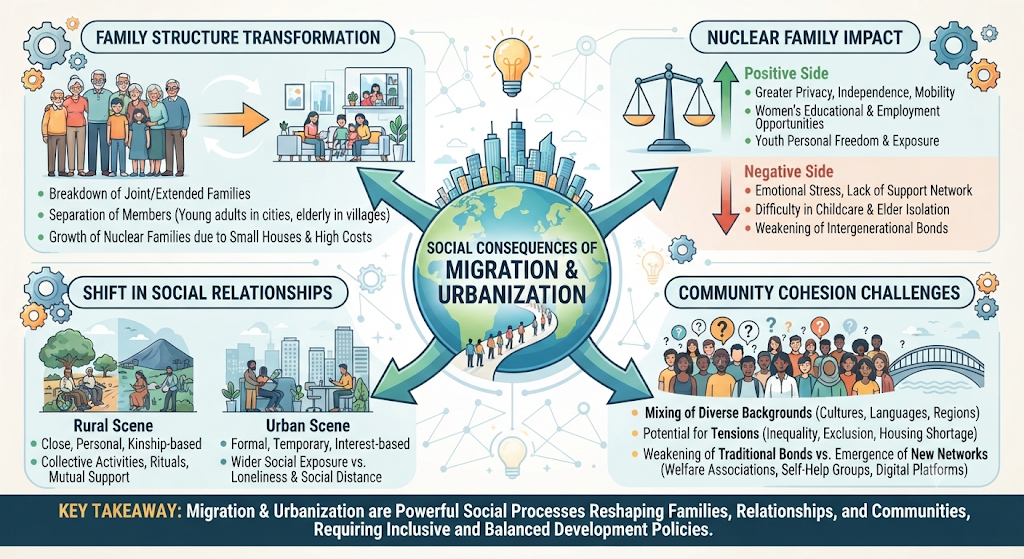
One of the most important effects of migration and urbanization is seen in family structure. Traditional societies often have joint or extended families, where several generations live together and share responsibilities. In such families, emotional support, economic cooperation, childcare, elderly care, and social values are collectively maintained. However, migration often separates family members. Young adults may move to cities for work while elderly parents, spouses, or children remain in villages. In urban areas, small houses, high living costs, job mobility, and individual lifestyles encourage the growth of nuclear families.
This transformation from joint family to nuclear family has both positive and negative effects. Nuclear families may provide greater privacy, independence, mobility, and decision-making freedom. Women may gain more opportunities for education and employment. Youth may experience greater personal freedom and exposure to new ideas. However, nuclear families may also face emotional stress, lack of support, difficulty in childcare, isolation of elderly persons, and weakening of intergenerational bonds.
Migration and urbanization also influence social relationships. In rural communities, social relationships are generally close, personal, and based on kinship, neighbourhood, caste, religion, occupation, and community traditions. People usually know each other and participate in collective activities, rituals, festivals, and mutual support systems. In contrast, urban relationships are often more formal, temporary, and based on occupation, education, residence, or economic interest. Urban life may provide wider social exposure but may also create loneliness and social distance.
Migrants in cities often face adjustment challenges. They may struggle with language differences, cultural change, discrimination, insecure employment, poor housing, and lack of social support. Many migrants live in informal settlements or rented rooms with limited access to basic services. These conditions may affect their dignity, health, family stability, and social participation. However, migrants also create new social networks through workplaces, community associations, religious groups, labour groups, neighbourhoods, and digital platforms.
Community cohesion is another important area affected by migration and urbanization. Community cohesion means the strength of social bonds, mutual trust, cooperation, shared identity, and peaceful coexistence among people. In rapidly urbanizing societies, people from different regions, cultures, languages, religions, and economic backgrounds live together. This diversity can enrich urban life, but it can also create tensions if there is inequality, exclusion, lack of housing, unemployment, or weak governance.
Urbanization may weaken traditional community cohesion because city life is often fast, competitive, and individualistic. People may have less time for social interaction and collective activities. Neighbourhood relations may become weak, and community participation may decline. At the same time, new forms of cohesion may emerge through resident welfare associations, migrant networks, self-help groups, workplace communities, social media groups, and civil society organizations.
The present study is significant because it examines the social consequences of economic development and urban growth. While migration and urbanization are important for economic progress, they also create social challenges that need careful attention. Understanding these changes can help policymakers, urban planners, sociologists, community organizations, and development agencies design better policies for inclusive and socially balanced urban development.
Thus, migration and urbanization are not only economic or demographic processes; they are also powerful social processes. They reshape families, change relationships, transform communities, and redefine social identity. Therefore, studying their impact is essential for building inclusive, supportive, and cohesive societies in emerging economies.
Impact of Migration and Urbanization on Family Structure#
Migration and urbanization have brought major changes in family structure in emerging economies. Traditionally, many societies were based on joint or extended family systems, where parents, children, grandparents, uncles, aunts, and other relatives lived together or remained closely connected. Such families provided emotional support, financial cooperation, childcare, elderly care, social guidance, and cultural continuity. However, with rapid migration and urban growth, this traditional family structure is changing.
People migrate to cities mainly for employment, education, healthcare, better income, and improved living standards. When young adults move from villages to cities, they often live separately from their parents and extended family members. Due to high housing costs, limited space, busy work schedules, and urban lifestyles, nuclear families become more common. A nuclear family usually consists of husband, wife, and children living separately from the larger family network.
This shift has both positive and negative effects. On the positive side, nuclear families may provide independence, privacy, mobility, and freedom in decision-making. Young couples may make their own choices regarding education, employment, family planning, and lifestyle. Women may also get more opportunities for education, jobs, and economic participation in urban areas.
On the negative side, migration may weaken intergenerational bonds. Elderly parents may remain in rural areas without regular care and emotional support. Children may grow up away from grandparents and traditional cultural guidance. Working parents in cities may face difficulty in childcare due to lack of family support. This can increase dependence on paid childcare, domestic workers, or schools.
Migration may also create separated families. In many cases, one member migrates for work while the rest of the family remains in the village. This may improve household income through remittances, but it may also create emotional distance, loneliness, marital stress, and parenting challenges. Children may miss the guidance of a migrant parent, while spouses may carry greater household responsibilities.
Urbanization also changes gender roles within the family. Women in cities may participate more in paid work, decision-making, and public life. This can improve their status and confidence. However, it may also increase their burden because they may have to manage both employment and household responsibilities. Thus, migration and urbanization transform family structure from joint to nuclear, from collective to more individual-based, and from traditional roles to changing gender and generational roles. These changes reflect both opportunities and challenges in emerging economies.
Challenges and Policy Measures in Emerging Economies#
Migration and urbanization create several challenges for emerging economies. One major challenge is unplanned urban growth. Many cities expand rapidly without sufficient housing, transport, sanitation, schools, hospitals, and employment opportunities. As a result, migrants often live in informal settlements, rented rooms, overcrowded colonies, or temporary shelters. Such living conditions affect family life, health, safety, and dignity.
Another challenge is the weakening of traditional support systems. Migrants who move away from their families may lose access to emotional, social, and cultural support. Nuclear families in cities may struggle with childcare, elderly care, loneliness, and work-life balance. Elderly persons left behind in rural areas may experience isolation and insecurity.
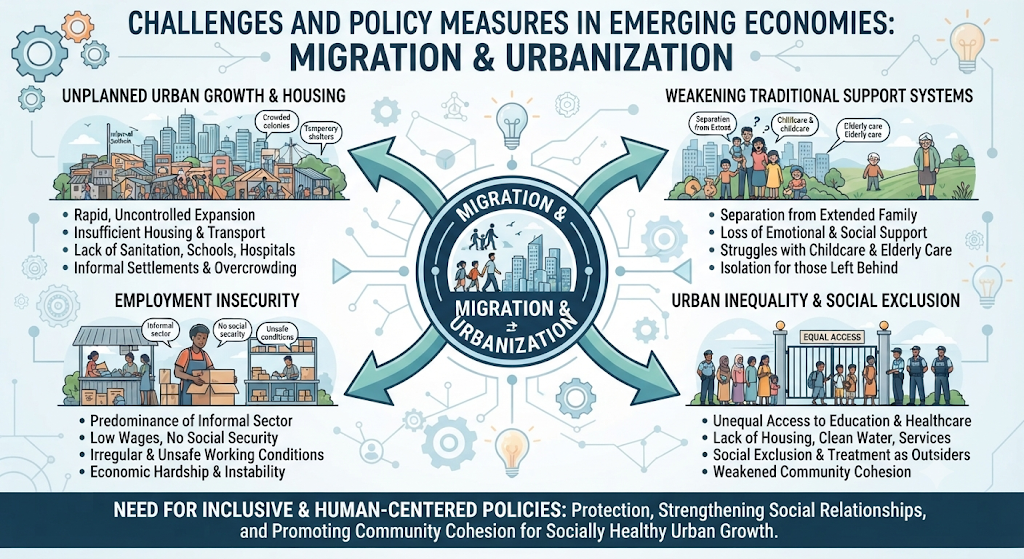
Employment insecurity is also a major issue. Many migrants work in informal sectors with low wages, no social security, irregular employment, and unsafe working conditions. Economic insecurity affects family stability and social relationships. It may also create stress, conflict, and poor quality of life.
Urban inequality is another serious problem. Migrants and low-income groups may not have equal access to education, healthcare, housing, clean water, and public services. Social exclusion may increase if migrants are treated as outsiders. This weakens community cohesion and may create conflict between different groups.
To address these challenges, emerging economies need inclusive and human-centered urban policies. Governments should provide affordable housing, skill development, employment support, healthcare, education, and social security for migrant workers and their families. Urban planning should include low-income groups and not only focus on commercial development.
Community development programmes should be promoted in migrant settlements and urban neighbourhoods. These may include counselling services, childcare centres, elderly support systems, women’s self-help groups, youth clubs, local dispute-resolution systems, and cultural integration programmes.
Digital technology can also support migrant families. Mobile banking, digital identity, online education, telemedicine, and digital communication can help migrants remain connected with families and access services. However, digital inclusion must be ensured for poor and less-educated migrants.
Educational institutions, NGOs, local governments, and community leaders should work together to promote social harmony, tolerance, and cooperation. Awareness programmes can reduce discrimination and improve understanding between migrants and local communities.
Thus, migration and urbanization require balanced policies that protect families, strengthen social relationships, and promote community cohesion. Inclusive development is necessary so that urban growth becomes socially healthy and not merely economically productive.
Conclusion#
The study concludes that migration and urbanization have a significant impact on family structure, social relationships, and community cohesion in emerging economies. Migration from rural to urban areas creates new opportunities for employment, education, income generation, healthcare, and social mobility. However, it also brings major changes in traditional social life. One of the most visible changes is the transformation of family structure. Joint and extended families are gradually shifting toward nuclear and separated family systems due to employment mobility, limited urban housing, high living costs, and individual lifestyles. This change provides independence and economic opportunity, but it may also weaken intergenerational support, childcare systems, elderly care, and emotional bonding. Migration and urbanization also change social relationships. Rural relationships are generally close, personal, and community-based, while urban relationships are often formal, temporary, and occupation-based. Migrants may experience loneliness, social isolation, adjustment problems, and cultural differences. At the same time, new social networks may develop through workplaces, migrant associations, neighbourhood groups, and digital communication.
Community cohesion is also affected by rapid urban growth. Diversity in urban areas can promote cultural exchange and social mobility, but unplanned urbanization, overcrowding, inequality, informal settlements, discrimination, and weak civic participation may reduce mutual trust and cooperation. Therefore, inclusive urban planning, affordable housing, social security, migrant support systems, community development programmes, and participatory governance are necessary. The migration and urbanization are not only economic processes but also deep social processes. If managed properly, they can support inclusive development, social mobility, and community harmony. If neglected, they may create family stress, social distance, and weakened community cohesion. Therefore, emerging economies must balance economic growth with social protection and community-building policies.
Works Cited#
- Castells, Manuel. The Urban Question: A Marxist Approach. MIT Press, 1977.
- Davis, Kingsley. “The Urbanization of the Human Population.” Scientific American, vol. 213, no. 3, 1965, pp. 40–53.
- Durkheim, Emile. The Division of Labour in Society. Free Press, 1984.
- Giddens, Anthony. Sociology. 8th ed., Polity Press, 2017.
- Glick Schiller, Nina, Linda Basch, and Cristina Szanton Blanc. “From Immigrant to Transmigrant: Theorizing Transnational Migration.” Anthropological Quarterly, vol. 68, no. 1, 1995, pp. 48–63.
- Goldscheider, Calvin. Urban Migrants in Developing Nations: Patterns and Problems of Adjustment. Westview Press, 1983.
- Harvey, David. Social Justice and the City. University of Georgia Press, 2009.
- International Organization for Migration. World Migration Report 2024. IOM, 2024.
- Lee, Everett S. “A Theory of Migration.” Demography, vol. 3, no. 1, 1966, pp. 47–57.
- Lewis, Oscar. “Urbanization without Breakdown: A Case Study.” Scientific Monthly, vol. 75, no. 1, 1952, pp. 31–41.
- Massey, Douglas S., et al. “Theories of International Migration: A Review and Appraisal.” Population and Development Review, vol. 19, no. 3, 1993, pp. 431–466.
- Park, Robert E., Ernest W. Burgess, and Roderick D. McKenzie. The City. University of Chicago Press, 1925.
- Portes, Alejandro, and Rubén G. Rumbaut. Immigrant America: A Portrait. 4th ed., University of California Press, 2014.
- Putnam, Robert D. Bowling Alone: The Collapse and Revival of American Community. Simon & Schuster, 2000.
- Redfield, Robert. The Folk Culture of Yucatan. University of Chicago Press, 1941.
- Sassen, Saskia. The Global City: New York, London, Tokyo. Princeton University Press, 2001.
- Simmel, Georg. “The Metropolis and Mental Life.” The Sociology of Georg Simmel, translated by Kurt H. Wolff, Free Press, 1950, pp. 409–424.
- Todaro, Michael P. “A Model of Labor Migration and Urban Unemployment in Less Developed Countries.” American Economic Review, vol. 59, no. 1, 1969, pp. 138–148.
- United Nations Department of Economic and Social Affairs. World Urbanization Prospects: The 2018 Revision. United Nations, 2019.
- Wirth, Louis. “Urbanism as a Way of Life.” American Journal of Sociology, vol. 44, no. 1, 1938, pp. 1–24.