Abstract
Climate-resilient agriculture is essential for achieving the Sustainable Development Goals because climate change simultaneously affects food production, water availability, biodiversity, human health, rural employment, poverty, and social stability. Multidisciplinary approaches integrate agronomy, soil science, hydrology, climatology, ecology, economics, sociology, engineering, biotechnology, information technology, public health, and policy studies to develop agricultural systems capable of anticipating, absorbing, and recovering from climatic shocks. Major strategies include crop diversification, climate-resilient varieties, conservation agriculture, agroforestry, integrated crop–livestock systems, efficient irrigation, soil-carbon management, renewable energy, weather forecasting, digital advisory services, insurance, and inclusive rural institutions. These interventions contribute directly to SDG 2 by improving food security and sustainable production, while also supporting poverty reduction, gender equality, clean water, decent employment, responsible consumption, climate action, biodiversity conservation, and institutional partnerships. However, climate-resilient agriculture cannot be achieved through isolated technologies. Its effectiveness depends upon local knowledge, farmer participation, reliable climate information, affordable finance, equitable access to resources, supportive markets, interdisciplinary research, and coordinated governance. Smallholders, women, indigenous communities, tenant farmers, and agricultural labourers require particular attention because they often experience high climate exposure but possess limited adaptive resources. Monitoring frameworks should evaluate productivity, resilience, mitigation, income, nutrition, equity, water use, soil quality, biodiversity, and unintended trade-offs. By combining scientific knowledge with community experience and aligning agricultural policies with broader development priorities, multidisciplinary climate-resilient agriculture can strengthen food systems, protect ecosystems, improve rural livelihoods, and accelerate progress toward the interconnected Sustainable Development Goals.
- Climate-resilient agriculture
- Sustainable Development Goals
- multidisciplinary approaches
- climate adaptation
- food security
- sustainable farming
- agricultural resilience
- rural livelihoods
- ecosystem management
- climate-smart technology
Introduction#
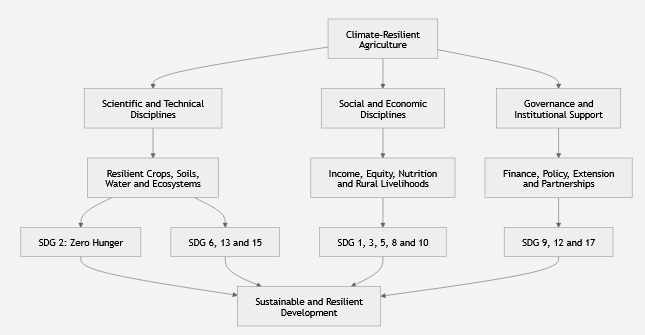
Climate change has emerged as one of the most serious threats to agriculture and sustainable development because farming depends directly on temperature, rainfall, soil moisture, water availability, biodiversity, and the stability of natural ecosystems. Increasing temperatures, irregular monsoons, droughts, floods, heat waves, cyclones, salinity, changing pest distributions, and extreme rainfall events affect crop yields, livestock health, fisheries, farm infrastructure, labour productivity, and rural income. These impacts are particularly severe in developing countries, where large populations depend on smallholder agriculture and possess limited access to irrigation, insurance, technology, credit, storage, and climate information. Climate-resilient agriculture seeks to strengthen the ability of farming systems and rural communities to anticipate climatic risks, reduce exposure and sensitivity, absorb shocks, recover after losses, and adapt to long-term environmental change. It combines productivity improvement, adaptation, risk management, and, where possible, mitigation of greenhouse-gas emissions. However, agricultural resilience cannot be created through agronomic intervention alone. Climate risks involve complex interactions among ecological processes, economic conditions, social inequalities, infrastructure, technology, governance, health, markets, and cultural practices. Multidisciplinary collaboration is therefore necessary. Agronomy contributes improved cropping systems, planting methods, and nutrient-management practices; plant breeding and biotechnology develop varieties tolerant to drought, heat, salinity, floods, pests, and diseases; soil science supports organic-matter restoration, erosion control, and nutrient cycling; hydrology and engineering improve irrigation, drainage, water harvesting, storage, machinery, and renewable-energy systems; climatology and meteorology provide forecasts and risk assessments; ecology contributes biodiversity conservation, agroforestry, pollinator protection, and ecosystem-based adaptation; economics evaluates costs, benefits, insurance, markets, incentives, and livelihood diversification; sociology and gender studies examine adoption behaviour, social inequality, local knowledge, collective action, and resource access; information technology supports remote sensing, artificial intelligence, sensors, digital advisory platforms, and early-warning systems; while public policy coordinates institutions, finance, research, extension, and development planning. These contributions are closely related to the United Nations Sustainable Development Goals. Climate-resilient agriculture directly supports SDG 2, which focuses on ending hunger, improving nutrition, and promoting sustainable agriculture. By stabilizing farm income and creating livelihood opportunities, it contributes to SDG 1 and SDG 8. Efficient irrigation, watershed management, and pollution control support SDG 6, while renewable energy and energy-efficient technologies contribute to SDG 7. Women’s access to land, finance, extension, and technology advances SDG 5. Responsible input use, food-loss reduction, residue recycling, and circular value chains support SDG 12. Carbon sequestration, lower emissions, and adaptation directly address SDG 13, while soil, forest, and biodiversity conservation advance SDG 15. Climate-resilient agriculture can also improve health and nutrition under SDG 3, strengthen innovation under SDG 9, reduce inequality under SDG 10, and encourage collaboration under SDG 17. Because these goals are interconnected, progress in one area can create benefits or trade-offs in another. For example, expanding irrigation may strengthen food security but increase groundwater depletion unless supported by water governance. Multidisciplinary planning is consequently essential for identifying solutions that are productive, equitable, resource-efficient, and ecologically sustainable.
 Top of Form
Figure: Multidisciplinary Climate-Resilient Agriculture and the SDG
Integration of Agricultural, Ecological and Climate Sciences for Resilient Production#
The integration of agronomy, plant science, soil science, ecology, hydrology, climatology, livestock science, and biotechnology provides the biophysical foundation of climate-resilient agriculture. Agronomic diversification is a central strategy because farms dependent on a single crop or variety are highly vulnerable to drought, floods, pests, diseases, and market disturbances. Crop rotation, intercropping, mixed cropping, relay cropping, integrated crop–livestock systems, and the inclusion of pulses, millets, oilseeds, fodder crops, vegetables, and locally adapted species distribute production risks across different enterprises. Diversification can improve nutrient cycling, interrupt pest and disease cycles, stabilize income, increase dietary diversity, and protect production when one crop fails. Plant breeders and biotechnologists contribute by developing varieties with tolerance to heat, drought, salinity, submergence, frost, and emerging pests. Early-maturing varieties can escape terminal drought or heat, while deep-rooted and water-efficient crops can perform better under moisture stress. Participatory plant breeding strengthens this process by involving farmers in the selection of varieties under real local conditions, ensuring that yield, taste, fodder quality, storage, cultural preference, and marketability are considered alongside stress tolerance. Seed banks, community nurseries, and diversified seed systems are essential for maintaining access to locally suitable genetic resources. Soil scientists contribute through conservation tillage, residue retention, cover cropping, compost application, biochar, green manuring, balanced fertilization, erosion control, and integrated nutrient management. Increasing soil organic matter improves aggregation, water infiltration, nutrient retention, microbial activity, and moisture availability, thereby helping crops withstand drought and intense rainfall. Contour farming, terraces, grassed waterways, vegetative barriers, and windbreaks protect soil against erosion. Hydrologists and agricultural engineers support farm ponds, check dams, rainwater harvesting, groundwater recharge, drainage, drip irrigation, sprinklers, soil-moisture sensors, and deficit-irrigation strategies. Water planning must consider the complete watershed because uncontrolled groundwater pumping or upstream diversion can transfer climate risks to other users. Agroforestry integrates trees with crops and livestock to provide shade, fodder, fruits, timber, fuelwood, carbon storage, wind protection, nutrient cycling, and habitat for beneficial organisms. Trees with deep roots may access water and nutrients unavailable to shallow-rooted crops, although species selection and spacing are necessary to prevent excessive competition. Ecologists contribute ecosystem-based adaptation by restoring wetlands, riparian vegetation, forests, grasslands, pollinator habitats, and landscape connectivity. Biodiversity increases functional redundancy, allowing ecological processes to continue when particular species or components are disturbed. Livestock specialists develop heat-tolerant breeds, improved shelters, balanced feeding, fodder banks, water-management practices, vaccination programmes, and disease-surveillance systems. Integrated crop–livestock systems recycle manure and crop residues, diversify income, and reduce dependence on a single production source. Climate scientists provide historical trend analysis, seasonal forecasts, extreme-event projections, agroclimatic zoning, and crop-weather models. Their information helps determine sowing windows, crop choices, irrigation needs, pest risks, and long-term investment priorities. Climate information must be translated into locally meaningful advice because probabilities and technical forecasts may be difficult for farmers to interpret. Collaboration among meteorologists, agronomists, extension workers, and farmer organizations can convert forecasts into crop-specific recommendations. The integrated approach must also examine trade-offs. Residue retention may improve soil but reduce livestock fodder; water-efficient irrigation may encourage expansion of irrigated land; and high-yielding varieties may require inputs inaccessible to poorer farmers. Multidisciplinary assessment helps balance these competing objectives. By combining diversified production, resilient genetics, healthy soil, efficient water use, ecosystem restoration, livestock management, and climate science, farms can maintain productivity under stress while contributing to food security, water conservation, climate action, and biodiversity-related SDGs.
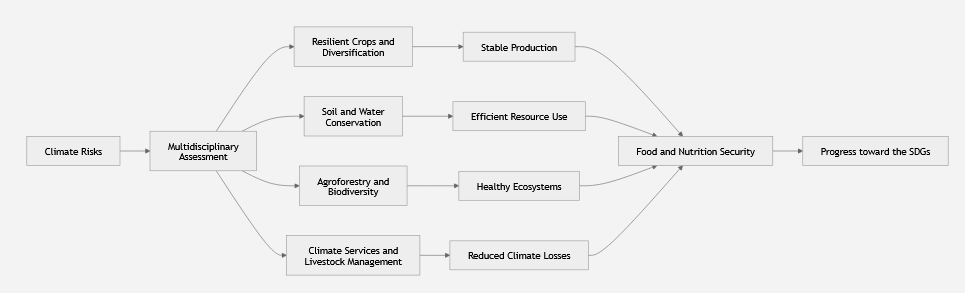
Figure: Integrated Climate-Resilient Agricultural System
Socio-Economic, Gender and Livelihood Dimensions of Climate Resilience#
Climate resilience is shaped not only by agricultural technology but also by income, land ownership, education, gender, social identity, labour relations, institutions, market access, health, and household decision-making. Farmers facing the same climatic event may experience very different outcomes because their adaptive capacities are unequal. Large landowners may have access to irrigation, savings, machinery, insurance, credit, storage, and diversified markets, whereas tenant farmers, agricultural labourers, women, indigenous groups, and marginal producers may depend on rainfed land and informal finance. A multidisciplinary socio-economic approach examines who is exposed to climate risk, who controls resources, who receives information, who bears the cost of adaptation, and who benefits from agricultural programmes. Poverty reduction under SDG 1 is closely linked with climate resilience because households with limited assets may sell livestock, reduce food consumption, withdraw children from school, or borrow at high interest after crop failure. These coping strategies can create long-term poverty traps. Social-protection measures such as public employment, cash transfers, food support, emergency credit, livestock assistance, and input packages can prevent temporary climatic shocks from becoming permanent livelihood crises. Agricultural insurance can compensate losses associated with drought, floods, storms, or yield decline. Weather-index and satellite-based insurance may reduce assessment costs, but the selected index must accurately represent farmers’ actual losses. Transparent contracts, affordable premiums, timely payments, grievance procedures, and financial education are necessary for building trust. Livelihood diversification strengthens resilience by reducing dependence on a single crop or season. Agro-processing, livestock rearing, beekeeping, mushroom cultivation, fisheries, forestry, renewable-energy services, machinery hiring, handicrafts, and rural tourism can provide additional sources of income. Value addition through cleaning, grading, storage, processing, packaging, and direct marketing improves farmers’ share of consumer expenditure and creates rural employment under SDG 8. Farmer-producer organizations and cooperatives can aggregate produce, purchase inputs, operate machinery, share storage, obtain certification, negotiate prices, and access institutional finance. Collective action is particularly important for watershed management, irrigation systems, grazing land, forests, seed banks, and disaster preparedness. Gender analysis is essential because women contribute extensively to agricultural production but frequently have weaker rights to land, finance, training, machinery, extension services, digital tools, and decision-making. Climate change can increase women’s workloads by extending the time required to collect water, fuel, fodder, and food. Gender-responsive resilience must provide secure land and inheritance rights, accessible credit, women-friendly machinery, childcare support, leadership opportunities, technical education, and equal participation in producer organizations. Advisory programmes should schedule training at convenient times, recruit women extension workers, and use communication channels accessible to women. Indigenous and local knowledge also contributes significantly to resilience. Communities possess experience concerning traditional varieties, water harvesting, mixed farming, weather indicators, medicinal plants, livestock breeds, soil management, and collective resource governance. Scientific institutions should document and test this knowledge respectfully rather than treating farmers as passive recipients of technology. Participatory research allows communities to define problems, compare alternatives, conduct field trials, and evaluate results. Nutrition and public health must also be integrated. Climate-resilient agriculture should not focus only on the quantity of staple crops; it should promote pulses, fruits, vegetables, livestock products, and traditional nutrient-rich foods. Reduced pesticide exposure, safer water, occupational protection, heat-stress management, and healthier diets contribute to SDG 3. Education, extension, and digital literacy strengthen farmers’ ability to understand forecasts, evaluate technologies, and participate in markets. Ultimately, equitable climate resilience requires that agricultural transformation improve capabilities and opportunities across social groups. Technologies that increase average yield but exclude poor farmers, displace labour without alternatives, or intensify women’s unpaid work cannot fully support sustainable development.
Engineering, Digital Technologies and Data-Driven Agricultural Decision-Making#
Engineering and digital innovation strengthen climate-resilient agriculture by improving the ability to monitor conditions, predict risks, optimize inputs, automate operations, and communicate timely recommendations. Agricultural engineers develop water-harvesting structures, efficient irrigation systems, protected cultivation, drainage networks, renewable-energy equipment, climate-controlled livestock housing, post-harvest facilities, and machines suitable for conservation agriculture. Solar-powered irrigation, cold storage, dryers, milk chillers, and processing equipment can reduce dependence on fossil fuels while limiting post-harvest losses. Nevertheless, solar pumping must be combined with groundwater regulation because low energy costs may encourage excessive water withdrawal. Protected cultivation—including greenhouses, shade nets, low tunnels, and hydroponic systems—can reduce exposure to extreme temperature, rainfall, wind, and pest pressure, but construction costs and energy requirements must be evaluated. Conservation-agriculture machinery enables direct sowing, minimum soil disturbance, crop-residue retention, and precise placement of seed and fertilizer. Small-scale and gender-responsive machines can reduce labour shortages and physical drudgery without excluding farmers with limited land. Digital technologies enhance engineering systems by generating real-time information. Soil-moisture sensors, automatic weather stations, satellite imagery, drones, livestock devices, machinery monitors, and farm-management applications collect data on field and animal conditions. Artificial intelligence and big data analytics identify patterns, forecast yield, estimate irrigation demand, detect crop stress, classify diseases, predict pest outbreaks, and recommend management actions. Remote sensing can monitor vegetation health, drought, flood extent, water bodies, land degradation, and crop area across large regions. Geographic information systems combine these observations with soil, topography, infrastructure, population, and market data to identify climate-vulnerable zones and prioritize intervention. Agricultural decision support systems integrate climate forecasts, crop models, field observations, economic information, and farmer preferences. They may recommend a planting date, crop variety, irrigation schedule, fertilizer rate, pest-control action, harvesting window, or marketing strategy. Mobile applications, text messages, call centres, community radio, voice assistants, and digital kiosks can deliver advice to farmers. Voice-based services and local-language interfaces are especially valuable for users with limited literacy. Early-warning systems should establish a clear connection between information and action. A flood forecast has limited value unless communities know where to move livestock, protect seed, reinforce storage, access emergency credit, and restore production afterward. Communication specialists, disaster-management agencies, extension workers, local governments, and farmer organizations must therefore work with climate scientists and engineers. Digital technologies can additionally improve access to finance, insurance, markets, and public programmes. Satellite data may support crop-loss assessment, digital platforms can connect farmers with buyers, and blockchain-based systems may improve traceability. However, digital agriculture involves important risks. Rural connectivity and electricity remain unreliable in many areas, while sensors, drones, subscriptions, and precision machinery may be unaffordable. Fragmented platforms and proprietary data formats reduce interoperability. Inaccurate models can generate damaging recommendations, particularly when training data do not represent local crops, soils, languages, or climatic conditions. Detailed farm data may be used without meaningful consent or may expose farmers to privacy, cybersecurity, pricing, credit, and land-related risks. Explainable artificial intelligence, data-minimization principles, secure storage, open standards, farmer data rights, and human oversight are therefore necessary. Technology must complement farmer experience rather than displace it. Public institutions can establish open agroclimatic databases, support locally validated tools, provide rural connectivity, and train extension personnel. Inclusive innovation should allow smallholders, women, and rural youth to participate in design, testing, ownership, and service delivery. When engineering and digital systems are affordable, transparent, interoperable, and locally appropriate, they can strengthen climate preparedness, improve resource efficiency, reduce production losses, and support SDGs related to innovation, energy, water, climate action, and sustainable production.
Governance, Policy Integration, Financing and Partnerships for Achieving the SDGs#
Climate-resilient agriculture requires coordinated governance because agricultural outcomes are influenced by policies concerning land, water, energy, forestry, biodiversity, rural development, trade, health, infrastructure, disaster management, research, and social protection. When ministries and agencies operate independently, one policy may undermine another. Electricity subsidies may encourage groundwater depletion, crop-price support may promote water-intensive monocultures, and poorly planned infrastructure may damage wetlands or increase flood exposure. A multidisciplinary governance framework aligns agricultural policy with climate commitments, biodiversity strategies, water plans, public-health objectives, rural employment, and the Sustainable Development Goals. National and regional resilience strategies should identify major climate hazards, vulnerable populations, priority commodities, ecological limits, institutional responsibilities, financing sources, and measurable outcomes. Local governments and community institutions are essential because adaptation decisions depend on landscape conditions, livelihood systems, and social relationships that cannot be managed entirely from the national level. Participatory planning should include farmers, women, tenant cultivators, agricultural workers, indigenous communities, researchers, extension agencies, civil society, private enterprises, and financial institutions. Secure and equitable land tenure encourages investment in soil conservation, tree planting, irrigation, and long-term restoration. Water governance should regulate extraction, protect environmental flows, encourage collective management, and resolve conflicts among agricultural, domestic, industrial, and ecological users. Climate-resilient infrastructure—including roads, bridges, irrigation systems, warehouses, cold chains, communication networks, veterinary facilities, seed systems, and markets—must be designed for future climatic conditions rather than historical averages. Financing remains a major barrier, particularly for smallholders. Resilience investments often require high initial expenditure, while their benefits occur gradually or take the form of avoided future losses. Governments can provide concessional credit, credit guarantees, matching grants, targeted subsidies, tax benefits, insurance support, and payments for ecosystem services. Public finance should prioritize interventions that produce multiple benefits, such as watershed restoration, agroforestry, renewable energy, climate-resilient seed systems, soil-carbon improvement, and rural storage. Private investment can support irrigation, digital services, processing, renewable energy, logistics, and insurance, but strong regulation is needed to ensure affordability, transparency, environmental protection, and fair benefit sharing. Climate funds, development banks, philanthropic organizations, and international cooperation can support research, infrastructure, capacity building, and adaptation programmes. Payment mechanisms may reward carbon sequestration, biodiversity conservation, reduced fertilizer losses, or watershed services, but monitoring must be scientifically reliable and accessible to small farmers. Extension systems connect policy with practice. Extension workers require interdisciplinary training that enables them to discuss agronomy, climate risk, markets, nutrition, gender, digital tools, and financial planning. Farmer field schools, demonstration farms, climate information centres, community resource persons, and digital advisory services can strengthen knowledge exchange. Research institutions should form multidisciplinary teams and evaluate technologies across several seasons and social groups. Monitoring should move beyond simple counts of distributed seeds, machines, or training participants. Indicators should assess yield stability, farm income, soil organic matter, water productivity, emissions, biodiversity, dietary diversity, women’s decision-making, employment, adoption continuity, and recovery after climatic shocks. These indicators can reveal synergies and trade-offs among the SDGs. Partnerships under SDG 17 are fundamental because no institution possesses all the knowledge, finance, infrastructure, and social legitimacy required for transformation. Universities can produce evidence, governments can establish enabling policies, private firms can develop services, civil society can represent vulnerable communities, and farmer organizations can coordinate local action. Effective partnerships require clear responsibilities, transparent decision-making, shared data standards, accountability, and long-term commitment. Through integrated governance, inclusive finance, strong institutions, interdisciplinary research, and participatory monitoring, climate-resilient agriculture can become a practical pathway for achieving multiple Sustainable Development Goals rather than remaining a collection of isolated projects.
Conclusion#
Multidisciplinary approaches are essential for using climate-resilient agriculture as a pathway toward achieving the Sustainable Development Goals. Climate change affects agriculture through interacting environmental, economic, technological, social, and institutional processes; consequently, no single discipline or intervention can adequately address its effects. Agronomy and plant science contribute diversified cropping systems, stress-tolerant varieties, and improved management practices. Soil science and ecology support organic-matter restoration, erosion control, biodiversity conservation, agroforestry, and ecosystem-based adaptation. Hydrology and engineering improve water harvesting, irrigation, drainage, renewable energy, machinery, storage, and protected cultivation. Climatology provides forecasts and risk assessments, while artificial intelligence, remote sensing, sensors, and decision support systems translate large quantities of data into timely agricultural recommendations. Economics, sociology, gender studies, public health, and policy research ensure that proposed technologies are affordable, inclusive, nutritionally beneficial, socially acceptable, and institutionally feasible. Together, these disciplines can strengthen production, adaptation, mitigation, and rural livelihoods. The relationship between climate-resilient agriculture and the SDGs is broad and interconnected. Stable and sustainable production directly advances zero hunger, while improved farm income contributes to poverty reduction and decent employment. Diverse farming systems can support better nutrition and health. Women’s access to land, technology, extension, finance, and leadership advances gender equality. Efficient irrigation and watershed restoration promote water security, while renewable energy and efficient machinery support clean energy. Reduced food loss, precise input application, nutrient recycling, and circular value chains advance responsible production and consumption. Carbon storage, reduced emissions, and preparedness for extreme weather support climate action, while soil and biodiversity conservation protect terrestrial ecosystems. Innovation, infrastructure, reduced inequality, strong institutions, and partnerships provide the enabling foundation for these outcomes. Nevertheless, potential trade-offs must be recognized. Irrigation can stabilize yield but deplete groundwater; mechanization can reduce drudgery but displace workers; bioenergy can lower fossil-fuel use but compete with food or soil-residue needs; and digital systems can improve advice while increasing inequality or compromising data privacy. Multidisciplinary assessment helps identify and manage these tensions. Farmers and rural communities should participate throughout the design, testing, implementation, and evaluation of resilience programmes. Their knowledge of local soils, crops, weather, livestock, water, and social institutions is indispensable. Particular attention must be given to smallholders, women, tenant farmers, indigenous communities, and labourers who often face the greatest exposure and possess the fewest resources. Long-term progress requires coordinated policies, secure tenure, accessible finance, climate information, rural infrastructure, agricultural extension, social protection, research, and transparent monitoring. Success should be measured not only by higher average yield but also by yield stability, soil and water health, biodiversity, income distribution, nutrition, recovery from shocks, and community capacity. Through sustained cooperation among scientific disciplines, institutions, businesses, and farming communities, climate-resilient agriculture can protect natural resources, improve human well-being, transform food systems, and accelerate equitable progress across the Sustainable Development Goals.
Works Cited#
- Campbell, B. M., Thornton, P., Zougmoré, R., van Asten, P., & Lipper, L. (2014). Sustainable intensification: What is its role in climate-smart agriculture? Current Opinion in Environmental Sustainability, 8, 39–43.
- Challinor, A. J., Watson, J., Lobell, D. B., Howden, S. M., Smith, D. R., & Chhetri, N. (2014). A meta-analysis of crop-yield responses to adaptation. Nature Climate Change, 4(4), 287–291.
- FAO. (2010). Climate-smart agriculture: Policies, practices and financing for food security, adaptation and mitigation. Food and Agriculture Organization of the United Nations.
- FAO. (2013). Climate-smart agriculture sourcebook. Food and Agriculture Organization of the United Nations.
- FAO. (2017). Climate-smart agriculture sourcebook (2nd ed.). Food and Agriculture Organization of the United Nations.
- FAO. (2018). Climate change and food security: Risks and responses. Food and Agriculture Organization of the United Nations.
- FAO. (2021). The state of the world’s land and water resources for food and agriculture: Systems at breaking point. Food and Agriculture Organization of the United Nations.
- Harvey, C. A., Chacón, M., Donatti, C. I., Garen, E., Hannah, L., Andrade, A., Bede, L., Brown, D., Calle, A., Chará, J., Clement, C., Gray, E., Hoang, M. H., Minang, P., Rodríguez, A. M., Seeberg-Elverfeldt, C., Semroc, B., Shames, S., Smukler, S., & Wollenberg, E. (2014). Climate-smart landscapes: Opportunities and challenges for integrating adaptation and mitigation in tropical agriculture. Conservation Letters, 7(2), 77–90.
- Howden, S. M., Soussana, J. F., Tubiello, F. N., Chhetri, N., Dunlop, M., & Meinke, H. (2007). Adapting agriculture to climate change. Proceedings of the National Academy of Sciences, 104(50), 19691–19696.
- IPCC. (2022). Climate change 2022: Impacts, adaptation and vulnerability. Cambridge University Press.
- Lipper, L., Thornton, P., Campbell, B. M., Baedeker, T., Braimoh, A., Bwalya, M., Caron, P., Cattaneo, A., Garrity, D., Henry, K., Hottle, R., Jackson, L., Jarvis, A., Kossam, F., Mann, W., McCarthy, N., Meybeck, A., Neufeldt, H., Remington, T., Sen, P. T., Sessa, R., Shula, R., Tibu, A., & Torquebiau, E. F. (2014). Climate-smart agriculture for food security. Nature Climate Change, 4(12), 1068–1072.
- Lobell, D. B., Schlenker, W., & Costa-Roberts, J. (2011). Climate trends and global crop production since 1980. Science, 333(6042), 616–620.
- Morton, J. F. (2007). The impact of climate change on smallholder and subsistence agriculture. Proceedings of the National Academy of Sciences, 104(50), 19680–19685.
- Nelson, G. C., Rosegrant, M. W., Palazzo, A., Gray, I., Ingersoll, C., Robertson, R., Tokgoz, S., Zhu, T., Sulser, T. B., Ringler, C., Msangi, S., & You, L. (2010). Food security, farming, and climate change to 2050. International Food Policy Research Institute.
- Newell, P., Taylor, O., Naess, L. O., Thompson, J., Mahmoud, H., Ndaki, P., Rurangwa, R., & Teshome, A. (2019). Climate-smart agriculture? Governing the sustainable development goals in sub-Saharan Africa. Frontiers in Sustainable Food Systems, 3, 55.
- Pretty, J., Benton, T. G., Bharucha, Z. P., Dicks, L. V., Flora, C. B., Godfray, H. C. J., Goulson, D., Hartley, S., Lampkin, N., Morris, C., Pierzynski, G., Prasad, P. V. V., Reganold, J., Rockström, J., Smith, P., Thorne, P., & Wratten, S. (2018). Global assessment of agricultural system redesign for sustainable intensification. Nature Sustainability, 1(8), 441–446.
- Rosenstock, T. S., Lamanna, C., Chesterman, S., Bell, P., Arslan, A., Richards, M., Rioux, J., Akinleye, A. O., Champalle, C., Cheng, Z., Corner-Dolloff, C., Dohn, J., English, W., Eyrich, A. S., Girvetz, E. H., Kerr, A., Lizarazo, M., Madalinska, A., McFatridge, S., Morris, K. S., Namoi, N., Poultouchidou, N., Ravina da Silva, M., Rayess, S., Ström, H., Tully, K. L., & Zhou, W. (2016). The scientific basis of climate-smart agriculture: A systematic review protocol. CCAFS Working Paper No. 138.
- Smith, P., Martino, D., Cai, Z., Gwary, D., Janzen, H., Kumar, P., McCarl, B., Ogle, S., O’Mara, F., Rice, C., Scholes, B., & Sirotenko, O. (2008). Greenhouse gas mitigation in agriculture. Philosophical Transactions of the Royal Society B: Biological Sciences, 363(1492), 789–813.
- United Nations. (2015). Transforming our world: The 2030 Agenda for Sustainable Development. United Nations.
- World Bank. (2016). Climate-smart agriculture indicators. World Bank