Abstract

The present study examines how social entrepreneurship contributes to solving social, economic, and environmental problems through innovative and community-oriented approaches. Social entrepreneurship refers to entrepreneurial activities that aim not only to generate income but also to create positive social impact. Social entrepreneurs work to address issues such as poverty, unemployment, education gaps, healthcare access, women’s empowerment, environmental degradation, skill development, and social exclusion. The study focuses on how social entrepreneurship identifies local problems and develops sustainable solutions through innovation, community participation, resource mobilization, and inclusive business models. Unlike traditional entrepreneurship, social entrepreneurship gives equal importance to social welfare and economic viability. It promotes self-reliance, livelihood generation, local leadership, and empowerment of marginalized communities.

Keywords
  • Social Entrepreneurship
  • Community Challenges
  • Sustainable Development
  • Socio-Economic Development
  • Social Innovation
  • Community Empowerment
  • Inclusive Growth
  • Livelihood Generation
  • Social Enterprise
  • Sustainable Livelihoods

Introduction#

Social entrepreneurship has emerged as an important approach for addressing social and economic problems in contemporary society. It combines the principles of entrepreneurship with the goal of social welfare. While traditional entrepreneurship mainly focuses on profit generation, social entrepreneurship focuses on creating social value along with financial sustainability. Social entrepreneurs identify community problems and develop innovative solutions that improve the lives of people, especially marginalized and vulnerable groups. Communities face many challenges such as poverty, unemployment, illiteracy, poor healthcare access, gender inequality, environmental degradation, lack of skills, social exclusion, and limited livelihood opportunities. These problems are often complex and cannot be solved through short-term welfare measures alone. Social entrepreneurship provides practical and sustainable solutions by involving local people and using available resources effectively. Social entrepreneurs work in different areas such as education, health, agriculture, women’s empowerment, waste management, renewable energy, rural development, financial inclusion, disability support, and skill development. For example, a social enterprise may provide low-cost education, affordable healthcare, organic farming support, recycled products, microfinance services, or vocational training for youth and women. One of the major strengths of social entrepreneurship is innovation. Social entrepreneurs use creative ideas to solve social problems in cost-effective and sustainable ways. They develop new products, services, delivery models, and community-based systems that directly benefit people. Innovation helps make development more practical and accessible.
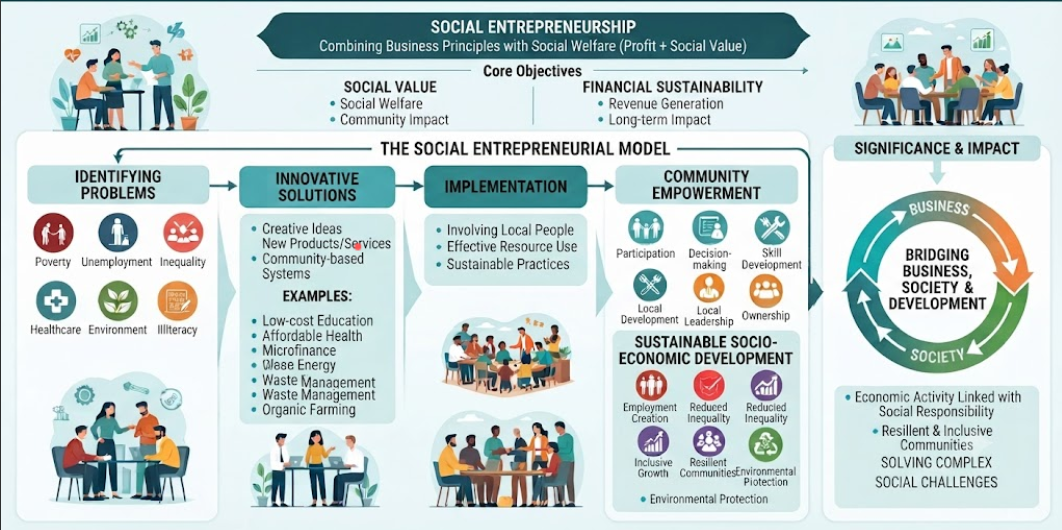
Figure: Understanding Social Entrepreneurship: Bridging Business, Society & sustainability

Social entrepreneurship also promotes community empowerment. It encourages local people to participate in decision-making, income generation, skill development, and problem-solving. Instead of treating communities only as beneficiaries, social entrepreneurship views them as partners in development. This strengthens self-confidence, ownership, and local leadership.

Sustainable socio-economic development requires both social progress and economic improvement. Social entrepreneurship contributes to this by creating employment, improving access to services, reducing inequality, supporting local enterprises, and protecting the environment. It promotes inclusive growth by ensuring that development benefits reach weaker sections of society.

The present study is significant because social entrepreneurship can act as a bridge between business, society, and development. It provides a model where economic activity is linked with social responsibility. In the present era of inequality, unemployment, and environmental concerns, social entrepreneurship can play a vital role in building resilient, inclusive, and sustainable communities.

Concept and Importance of Social Entrepreneurship#

Social entrepreneurship is an important concept in the field of development, business, and social change. It refers to entrepreneurial activities that are carried out with the main purpose of solving social, economic, or environmental problems. Unlike traditional entrepreneurship, which mainly focuses on profit generation, social entrepreneurship focuses on creating social value along with financial sustainability. A social entrepreneur identifies a social problem, develops an innovative solution, mobilizes resources, and works to create positive change in society.

The concept of social entrepreneurship is based on the idea that business methods can be used for public welfare. Social entrepreneurs use creativity, leadership, risk-taking ability, and management skills to address community challenges. They may work through social enterprises, non-profit organizations, cooperatives, self-help groups, community-based enterprises, or hybrid organizations. Their goal is not only to earn income but also to improve people’s lives.

Social entrepreneurship is important because many social problems cannot be solved by government schemes alone. Issues such as poverty, unemployment, illiteracy, poor healthcare, gender inequality, environmental degradation, social exclusion, and lack of skills require innovative and sustainable solutions. Social entrepreneurs fill this gap by designing practical models that directly serve communities.

One major feature of social entrepreneurship is social innovation. Social innovation means developing new ideas, services, products, or methods to solve social problems. For example, a social enterprise may provide affordable education to poor children, low-cost healthcare to rural communities, clean energy solutions, skill training for youth, or livelihood opportunities for women. These initiatives create both social and economic benefits.

Another important feature is community participation. Social entrepreneurship does not treat people only as beneficiaries. It involves them as partners, workers, decision-makers, and stakeholders. When communities participate in solving their own problems, they develop confidence, ownership, and self-reliance. This makes development more sustainable. Social entrepreneurship also promotes inclusive growth. Traditional economic growth may not always benefit poor and marginalized groups. Social enterprises focus on including weaker sections such as women, rural poor, persons with disabilities, migrants, small farmers, unemployed youth, and socially excluded communities. By providing skills, employment, services, and opportunities, social entrepreneurship reduces inequality. The importance of social entrepreneurship is also seen in livelihood generation. Many social enterprises create employment and self-employment opportunities at the local level. They support small businesses, handicrafts, agriculture-based enterprises, microfinance, waste recycling, eco-friendly products, and community services. This helps people earn income and improve their living conditions. Social entrepreneurship contributes to sustainable development. It balances economic, social, and environmental goals. Many social enterprises promote organic farming, renewable energy, water conservation, recycling, waste management, and eco-friendly production. Such activities protect the environment while creating livelihood opportunities.

Education is another area where social entrepreneurship is important. Social entrepreneurs may provide low-cost schools, digital learning centres, vocational training, libraries, mobile education units, and skill development programmes. These efforts help disadvantaged children and youth access learning opportunities. In healthcare, social entrepreneurship can improve access to affordable services. Social enterprises may provide low-cost clinics, telemedicine, health awareness campaigns, mobile medical vans, nutrition programmes, and mental health support. Such initiatives are especially useful in rural and underserved areas. Women’s empowerment is also strengthened through social entrepreneurship. Many organizations form women’s self-help groups, provide skill training, support micro-enterprises, and create market linkages for women’s products. This increases women’s income, confidence, decision-making power, and social status. Social entrepreneurship also develops leadership among local people. It encourages individuals to take initiative, identify problems, organize communities, and create solutions. Such leadership strengthens democratic participation and community development. Financial sustainability is an important aspect of social entrepreneurship. Unlike charity-based models that depend completely on donations, social enterprises try to generate income through their products or services. This helps them continue their work for a longer period. However, profit is used mainly to support the social mission rather than personal gain.

Social entrepreneurship is also important in promoting dignity. Instead of providing only temporary relief, it creates opportunities for people to become self-reliant. When people earn through their own skills and efforts, they gain confidence and respect in society. In the modern world, social entrepreneurship has become more relevant due to increasing inequality, unemployment, climate change, urban poverty, and social exclusion. It provides practical solutions that are flexible, innovative, and community-based. It connects business efficiency with social responsibility. Educational institutions also play a role in promoting social entrepreneurship. Universities and colleges can encourage students to develop social business ideas, participate in community projects, and create start-ups with social impact. This can develop socially responsible youth leadership. Government and policy support are also important. Social entrepreneurs need access to funding, training, legal support, markets, incubation centres, and partnerships. Supportive policies can help social enterprises grow and reach more communities.

Role of Social Entrepreneurship in Addressing Community Challenges#

Social entrepreneurship plays a significant role in addressing community challenges because it focuses on solving real-life problems through innovative, practical, and sustainable methods. Communities often face many difficulties such as poverty, unemployment, lack of education, poor healthcare, gender inequality, environmental pollution, social exclusion, lack of skills, and limited access to basic services. These challenges affect the overall development and quality of life of people. Social entrepreneurs identify such problems and develop solutions that are useful, affordable, and community-oriented.

One of the major roles of social entrepreneurship is poverty reduction. Poor communities often lack regular income, employment opportunities, financial support, and access to markets. Social entrepreneurs help reduce poverty by creating livelihood opportunities, supporting small businesses, providing skill training, and developing income-generating activities. For example, social enterprises may train rural women in tailoring, handicrafts, food processing, or digital services and help them sell their products. This improves income and self-reliance.

Social entrepreneurship also addresses unemployment, especially among youth and marginalized groups. Many young people have education but lack employable skills. Social enterprises provide vocational training, entrepreneurship training, digital literacy, technical skills, and job placement support. These programmes help youth become employable or start their own small ventures. By creating local employment opportunities, social entrepreneurship reduces migration and economic insecurity.

Education is another important community challenge addressed by social entrepreneurship. Many children from poor families face barriers such as lack of schools, poor teaching quality, digital divide, financial hardship, and dropout. Social entrepreneurs work to improve educational access through low-cost schools, community learning centres, digital education platforms, mobile libraries, scholarship support, remedial classes, and after-school programmes. Such initiatives help children continue their education and improve learning outcomes.

Social entrepreneurship also plays a vital role in healthcare access. Rural, remote, and low-income communities often face shortage of doctors, medicines, diagnostic services, and health awareness. Social enterprises may provide affordable clinics, mobile medical vans, telemedicine, low-cost medicines, health camps, nutrition programmes, maternal health services, and mental health support. These services reduce health inequalities and improve community well-being.

Women’s empowerment is strongly supported by social entrepreneurship. Many women face economic dependence, lack of education, social restrictions, domestic responsibilities, and limited decision-making power. Social enterprises promote women’s empowerment through self-help groups, microfinance, skill training, livelihood activities, leadership development, and market linkages. When women earn income and participate in decision-making, their status in family and society improves.

Social entrepreneurship also addresses the problem of social exclusion. Certain groups such as persons with disabilities, elderly persons, migrants, tribal communities, scheduled castes, minorities, and homeless persons may remain excluded from mainstream development. Social entrepreneurs design inclusive models that provide education, healthcare, employment, assistive devices, legal support, counselling, and social protection to these groups. This promotes dignity and equality.

Environmental challenges are also addressed through social entrepreneurship. Communities face problems such as waste accumulation, water scarcity, pollution, deforestation, soil degradation, and climate change. Social enterprises work in areas such as waste recycling, renewable energy, organic farming, water conservation, eco-friendly products, tree plantation, and sustainable livelihoods. These initiatives protect the environment while also creating employment.

Social entrepreneurship encourages community participation in problem-solving. Instead of imposing outside solutions, social entrepreneurs often involve local people in planning and implementation. Community members help identify problems, share local knowledge, contribute resources, and participate in decision-making. This creates ownership and makes solutions more sustainable.

Another important role of social entrepreneurship is promoting financial inclusion. Poor families often lack access to formal banking, credit, insurance, and savings facilities. Social enterprises and microfinance institutions help provide small loans, savings groups, financial literacy, digital payment training, and access to government schemes. Financial inclusion helps communities manage money, start businesses, and reduce dependence on moneylenders.

Social entrepreneurship also supports local resource utilization. Many communities have traditional skills, local materials, cultural knowledge, agricultural products, and human resources that remain underused. Social entrepreneurs help convert these local resources into sustainable livelihood opportunities. For example, local crafts, organic foods, herbal products, and eco-tourism can generate income while preserving culture and environment.

Community health and sanitation are also improved through social entrepreneurship. Some social enterprises work on clean drinking water, low-cost toilets, menstrual hygiene, waste management, nutrition, and hygiene awareness. These initiatives reduce disease burden and improve quality of life.

Social entrepreneurship also strengthens resilience during crises. During disasters, pandemics, floods, droughts, or economic shocks, social enterprises and community organizations provide relief, food, medicines, livelihood support, and rehabilitation. Their local presence helps them respond quickly to urgent community needs.

In rural development, social entrepreneurship can improve agriculture, animal husbandry, irrigation, market access, storage, processing, and farmer income. Social enterprises may help farmers adopt sustainable farming, get fair prices, reduce input costs, and connect with markets. This improves rural livelihoods and reduces economic vulnerability.

Social entrepreneurship also promotes awareness and behaviour change. Many community problems are connected with lack of awareness, harmful practices, or social attitudes. Social entrepreneurs conduct campaigns on education, health, gender equality, environment, financial literacy, digital safety, and legal rights. Awareness helps communities make informed decisions.

Technology-based social entrepreneurship is becoming increasingly important. Digital platforms can connect communities with education, healthcare, markets, banking, government schemes, and employment opportunities. Social entrepreneurs use mobile apps, online training, telemedicine, digital payments, and e-commerce to solve community problems more efficiently.

However, addressing community challenges through social entrepreneurship requires long-term commitment. Social problems are complex and cannot be solved through one-time interventions. Social entrepreneurs must understand local culture, build trust, involve communities, and create financially sustainable models. They must also work with government, NGOs, businesses, and local institutions.

Social Entrepreneurship and Sustainable Socio-Economic Development#

Social entrepreneurship plays an important role in promoting sustainable socio-economic development because it connects social welfare with economic growth. Sustainable socio-economic development means improving the living conditions of people in a way that is inclusive, long-lasting, and environmentally responsible. It focuses not only on income generation but also on equality, dignity, education, health, livelihood security, social participation, and protection of natural resources.

Social entrepreneurship supports sustainable development by creating solutions that are both socially useful and economically viable. Unlike short-term charity, social entrepreneurship tries to build models that can continue for a long time. For example, a social enterprise may provide skill training to poor women and also create a market for their products. This gives women income, confidence, and long-term livelihood support.

One of the major contributions of social entrepreneurship is employment generation. Many communities face unemployment and underemployment due to lack of skills, limited industries, poor market access, and social barriers. Social entrepreneurs create livelihood opportunities through small enterprises, cooperatives, self-help groups, community businesses, local production units, and service-based models. These activities improve household income and reduce poverty.

Social entrepreneurship also promotes inclusive growth. Economic development is meaningful only when its benefits reach weaker sections of society. Social enterprises often work with women, youth, small farmers, artisans, persons with disabilities, migrants, tribal communities, and low-income groups. By involving these communities in production, services, decision-making, and income generation, social entrepreneurship reduces inequality and promotes social justice.

Education and skill development are important parts of socio-economic development. Social entrepreneurs provide vocational training, digital literacy, entrepreneurship education, financial literacy, and life-skill programmes. These programmes help people become more employable and self-reliant. When youth and women gain skills, they can start small businesses, get jobs, or contribute more effectively to the local economy.

Social entrepreneurship also improves access to affordable services. In many communities, people cannot access quality education, healthcare, clean energy, sanitation, safe drinking water, and financial services. Social enterprises develop low-cost and community-based models to provide these services. This improves quality of life and strengthens human development.

Sustainable socio-economic development also requires women’s empowerment. Social entrepreneurship supports women through self-help groups, microfinance, training, market linkages, leadership opportunities, and home-based enterprises. When women become economically active, family welfare improves. Women’s income often supports children’s education, nutrition, healthcare, and household stability.

Social entrepreneurship contributes to rural development by using local resources and skills. Rural communities often have agricultural products, traditional crafts, local knowledge, natural resources, and human labour. Social enterprises can convert these resources into sustainable livelihood opportunities through processing, packaging, marketing, eco-tourism, organic farming, dairy, handicrafts, and digital services.

Environmental sustainability is another important contribution. Many social enterprises work on renewable energy, waste recycling, water conservation, organic farming, sustainable packaging, pollution control, and climate-friendly livelihoods. These initiatives protect the environment while creating economic opportunities. Thus, social entrepreneurship balances social, economic, and environmental goals.

Social entrepreneurship also promotes community ownership. Development becomes more sustainable when local people participate in planning and implementation. Social entrepreneurs often involve community members as workers, partners, customers, leaders, and decision-makers. This creates responsibility and strengthens long-term sustainability.

Financial inclusion is another important area. Many poor families do not have access to banks, credit, insurance, or savings systems. Social enterprises and community-based financial models provide microcredit, savings groups, digital payment awareness, and financial literacy. This helps people manage money, invest in livelihoods, and reduce dependence on moneylenders.

Social entrepreneurship also supports innovation in development. It creates new methods to solve old problems. For example, digital health platforms can reach remote areas, low-cost learning centres can support poor students, and recycled products can reduce waste while generating income. Innovation makes development more practical and accessible.

The impact of social entrepreneurship is not limited to individuals; it also strengthens communities. When people earn income, gain skills, participate in decision-making, and access services, the entire community becomes stronger. Social trust, cooperation, leadership, and local problem-solving capacity improve. Social entrepreneurship also helps reduce dependency on welfare. While welfare schemes are important, long-term development requires self-reliance. Social enterprises help people become producers, entrepreneurs, skilled workers, and active citizens. This shift from dependency to empowerment is central to sustainable socio-economic development. Partnerships are important for the success of social entrepreneurship. Social entrepreneurs often work with government agencies, NGOs, corporations, universities, financial institutions, and local communities. Such partnerships provide funding, training, technology, policy support, and market access. Collaboration increases the scale and impact of social enterprises. However, social entrepreneurship also faces challenges in promoting sustainable development. These include lack of funds, weak market access, limited managerial skills, difficulty in measuring social impact, legal barriers, and competition from commercial businesses. Social enterprises must maintain balance between social mission and financial survival. To strengthen social entrepreneurship, supportive policies are needed. Governments should provide incubation support, low-interest loans, tax benefits, training, market platforms, and recognition to social enterprises. Educational institutions should also encourage students to develop social enterprise ideas and work on community-based innovation.

Challenges and Future Prospects of Social Entrepreneurship#

Social entrepreneurship has great potential for addressing community challenges and promoting sustainable socio-economic development, but it also faces several challenges. These challenges may affect the growth, impact, and sustainability of social enterprises. Since social entrepreneurship works at the intersection of social welfare and business activity, it has to balance social mission with financial survival. This balance is often difficult, especially in poor and marginalized communities where people need affordable services but enterprises also need resources to continue their work.

One major challenge faced by social entrepreneurs is lack of finance. Social enterprises often work for disadvantaged communities, and their services or products are usually low-cost. Because of this, profit margins may be limited. Many investors prefer commercial businesses because they offer higher financial returns. Social entrepreneurs may therefore struggle to obtain loans, grants, seed funding, or investment. Without financial support, it becomes difficult to expand services, hire skilled workers, purchase equipment, or reach more beneficiaries.

Another challenge is limited market access. Many social enterprises produce goods such as handicrafts, organic products, recycled items, local food products, or women-made goods. However, they may find it difficult to connect with larger markets, online platforms, retailers, or buyers. Lack of branding, packaging, transport, and marketing knowledge may reduce their income. Without strong market linkages, community-based enterprises may not become financially sustainable.

Lack of managerial and technical skills is also a serious issue. Social entrepreneurs require knowledge of business planning, accounting, marketing, human resource management, technology, legal compliance, and impact assessment. Many social enterprises are started with strong social commitment but limited professional management capacity. This may affect planning, efficiency, quality control, and long-term survival.

Measuring social impact is another major challenge. Unlike ordinary businesses that measure success mainly through profit, social enterprises must measure both financial performance and social change. Impact may include improved income, better education, health improvement, women’s empowerment, environmental protection, or social inclusion. These outcomes are sometimes difficult to measure clearly. Without proper impact measurement, it becomes difficult to attract funders, partners, and policy support.
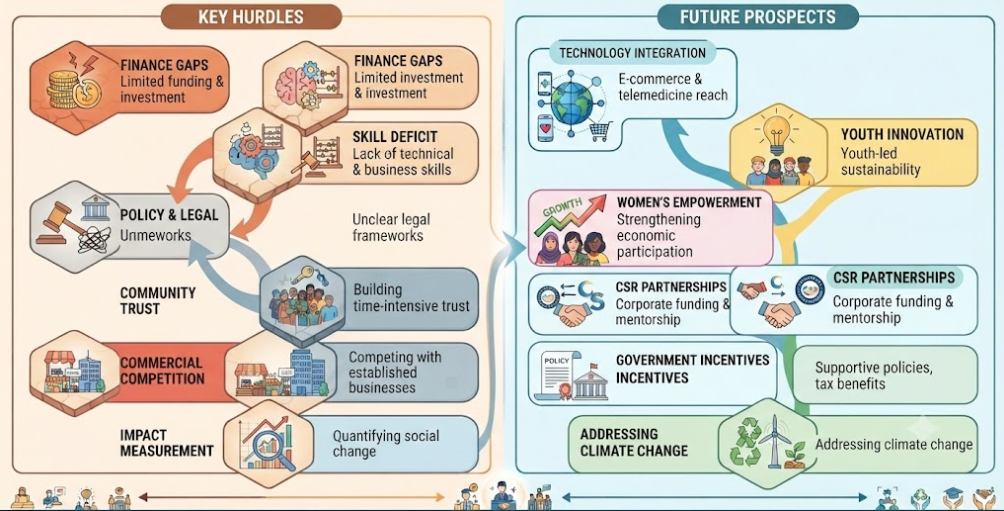
Figure: Overview of Challenges & Future prospects

Social entrepreneurship also faces legal and policy challenges. In many places, there may be no clear legal structure for social enterprises. They may have to register as NGOs, trusts, companies, cooperatives, or societies. Each structure has its own limitations. Lack of clear policy recognition may create difficulties in taxation, funding, reporting, and institutional support.

Community trust is another important challenge. Social entrepreneurs often work with communities that have faced poverty, exploitation, or failed development promises. People may initially hesitate to participate in new projects. Building trust requires time, transparency, regular communication, and genuine commitment. Without community trust, even good ideas may fail.

Balancing social mission and financial sustainability is one of the most complex challenges. If a social enterprise focuses too much on profit, it may lose its social purpose. If it focuses only on welfare without income generation, it may become financially weak. Therefore, social entrepreneurs must carefully design models that serve communities while also generating enough revenue for continuity.

Competition from commercial businesses can also affect social enterprises. Commercial companies may have better capital, marketing power, technology, and distribution networks. Social enterprises working with local communities may find it difficult to compete in terms of price, scale, and visibility. Supportive policies and fair market platforms are needed to help them survive.

Despite these challenges, the future prospects of social entrepreneurship are very promising. In the present world, social problems such as poverty, unemployment, climate change, inequality, lack of healthcare, and educational gaps require innovative solutions. Social entrepreneurship can provide practical and community-based answers to these challenges.

Technology will play an important role in the future of social entrepreneurship. Digital platforms can help social enterprises reach wider markets, provide online education, offer telemedicine, manage digital payments, collect data, and connect with supporters. E-commerce can help rural producers sell products beyond local markets. Mobile applications can support farmers, students, patients, and workers in remote areas.

Youth participation is another strong future prospect. Many young people are becoming interested in start-ups, innovation, sustainability, and social impact. Universities and colleges can promote social entrepreneurship through incubation centres, entrepreneurship cells, community projects, and skill-based training. Young social entrepreneurs can bring creativity, technology, and energy into development work.

Women-led social enterprises also have great future potential. Women’s self-help groups, micro-enterprises, digital businesses, food processing units, tailoring centres, handicraft groups, and service-based enterprises can strengthen women’s economic participation. Supporting women social entrepreneurs can improve household welfare, gender equality, and community development.

Corporate social responsibility can also support social entrepreneurship. Companies can partner with social enterprises for skill development, education, healthcare, environment, waste management, and livelihood projects. Such partnerships can provide funding, mentoring, technology, and market access. This can increase the reach and sustainability of social enterprises.

Government support is essential for future growth. Policies should provide easy registration, financial assistance, tax benefits, training, incubation, market linkages, and recognition for social enterprises. Government departments can also collaborate with social entrepreneurs in delivering community services and implementing welfare schemes.

Social entrepreneurship also has strong prospects in environmental sustainability. Enterprises working in recycling, renewable energy, organic farming, water conservation, sustainable packaging, eco-tourism, and climate adaptation can contribute to both livelihood and environmental protection. This is especially important in the context of climate change and resource depletion.

Conclusion#

The study concludes that social entrepreneurship plays a crucial role in addressing community challenges and promoting sustainable socio-economic development. By combining entrepreneurial principles with social objectives, social entrepreneurs develop innovative, practical, and sustainable solutions to problems such as poverty, unemployment, poor healthcare, educational inequalities, gender discrimination, environmental degradation, and social exclusion.

The study highlights that social entrepreneurship contributes significantly to community empowerment by creating livelihood opportunities, promoting skill development, encouraging local participation, and strengthening self-reliance among marginalized populations. Unlike traditional welfare approaches, social entrepreneurship emphasizes long-term sustainability, community ownership, and inclusive growth, thereby enabling individuals and communities to become active participants in their own development.

Social entrepreneurship also promotes sustainable socio-economic development by generating employment, improving access to essential services, supporting women’s empowerment, encouraging financial inclusion, and utilizing local resources effectively. Furthermore, many social enterprises adopt environmentally responsible practices such as waste management, renewable energy, organic farming, and resource conservation, thereby contributing to environmental sustainability.

However, the growth and effectiveness of social entrepreneurship are often constrained by challenges such as inadequate financial resources, limited market access, insufficient managerial capabilities, policy constraints, and difficulties in measuring social impact. Therefore, supportive government policies, financial assistance, capacity-building programmes, incubation facilities, technological support, and strong partnerships among government agencies, educational institutions, private organizations, and communities are essential for strengthening social entrepreneurship. The social entrepreneurship represents a powerful and transformative approach for creating positive social change, promoting inclusive development, and building resilient, self-reliant, and sustainable communities. In the contemporary world, where social and environmental challenges continue to increase, social entrepreneurship has immense potential to contribute significantly to equitable and sustainable socio-economic progress.

Works Cited#

  1. Bornstein, David. How to Change the World: Social Entrepreneurs and the Power of New Ideas. Oxford University Press, 2007.
  2. Dees, J. Gregory. “The Meaning of Social Entrepreneurship.” Stanford University, 1998.
  3. Defourny, Jacques, and Marthe Nyssens. “Conceptions of Social Enterprise and Social Entrepreneurship in Europe and the United States.” Journal of Social Entrepreneurship, vol. 1, no. 1, 2010, pp. 32–53.
  4. Drayton, Bill. “The Citizen Sector: Becoming as Entrepreneurial and Competitive as Business.” California Management Review, vol. 44, no. 3, 2002, pp. 120–132.
  5. Elkington, John, and Pamela Hartigan. The Power of Unreasonable People. Harvard Business Press, 2008.
  6. Leadbeater, Charles. The Rise of the Social Entrepreneur. Demos, 1997.
  7. Martin, Roger L., and Sally Osberg. “Social Entrepreneurship: The Case for Definition.” Stanford Social Innovation Review, vol. 5, no. 2, 2007, pp. 28–39.
  8. Mair, Johanna, Jeffrey Robinson, and Kai Hockerts, editors. Social Entrepreneurship. Palgrave Macmillan, 2006.
  9. Nicholls, Alex, editor. Social Entrepreneurship: New Models of Sustainable Social Change. Oxford University Press, 2006.
  10. Peredo, Ana María, and Murdith McLean. “Social Entrepreneurship: A Critical Review of the Concept.” Journal of World Business, vol. 41, no. 1, 2006, pp. 56–65.
  11. Prahalad, C. K. The Fortune at the Bottom of the Pyramid. Wharton School Publishing, 2005.
  12. Seelos, Christian, and Johanna Mair. “Social Entrepreneurship: Creating New Business Models to Serve the Poor.” Business Horizons, vol. 48, no. 3, 2005, pp. 241–246.
  13. Sen, Amartya. Development as Freedom. Oxford University Press, 1999.
  14. Shaw, Eleanor, and Sara Carter. “Social Entrepreneurship: Theoretical Antecedents and Empirical Analysis.” International Small Business Journal, vol. 25, no. 5, 2007, pp. 418–434.
  15. Thompson, John, Geoff Alvy, and Ann Lees. “Social Entrepreneurship: A New Look at the People and the Potential.” Management Decision, vol. 38, no. 5, 2000, pp. 328–338.
  16. United Nations Development Programme. Human Development Report 2023/2024. UNDP, 2024.
  17. Yunus, Muhammad. Banker to the Poor: Micro-Lending and the Battle against World Poverty. PublicAffairs, 2007.
  18. Yunus, Muhammad. Building Social Business. PublicAffairs, 2010.
  19. Zahra, Shaker A., et al. “A Typology of Social Entrepreneurs.” Journal of Business Venturing, vol. 24, no. 5, 2009, pp. 519–532.
  20. Zimmerer, Thomas W., Norman M. Scarborough, and Doug Wilson. Essentials of Entrepreneurship and Small Business Management. 7th ed., Pearson, 2014.

"Assessment of Public Awareness, Attitudes, and Participation in Environmental Conservation and Sustainable