Abstract
Climate change has emerged as one of the most significant challenges affecting agricultural productivity, food security, and rural livelihoods across the globe. Climate-Smart Agricultural Technologies (CSATs) have been developed to enhance agricultural productivity while improving resilience to climate variability and reducing greenhouse gas emissions. These technologies include conservation agriculture, precision farming, integrated nutrient management, drought-tolerant crop varieties, efficient irrigation systems, agroforestry, and digital advisory services. However, the successful implementation of these technologies largely depends on farmers' adoption behaviour, which is influenced by socio-economic, institutional, technological, psychological, and environmental factors. Understanding adoption behaviour is essential for designing effective policies and extension strategies that encourage widespread acceptance of climate-smart innovations. This study explores the determinants influencing farmers' adoption decisions, including education, farm size, access to credit, extension services, risk perception, awareness, social influence, market accessibility, and government support. It also examines barriers such as limited financial resources, inadequate technical knowledge, poor infrastructure, and uncertainty regarding technology performance. The study highlights the role of extension agencies, digital agriculture, farmer producer organizations, and participatory approaches in accelerating technology adoption. Promoting climate-smart agricultural technologies through capacity building, financial incentives, policy interventions, and improved information dissemination can significantly enhance climate resilience and sustainable agricultural development. The findings contribute to developing strategies that improve technology diffusion, strengthen farmers' adaptive capacity, increase productivity, and ensure long-term environmental sustainability under changing climatic conditions.
- Climate-Smart Agriculture
- Farmer Adoption Behaviour
- Sustainable Agriculture
- Climate Change Adaptation
- Agricultural Innovation
- Conservation Agriculture
- Precision Farming
- Extension Services
- Technology Adoption
- Resilient Farming Systems
Introduction#
Agriculture is one of the most climate-sensitive sectors of the global economy and serves as the primary source of livelihood for billions of people. Increasing temperatures, erratic rainfall, prolonged droughts, floods, cyclones, heat waves, and shifting pest and disease dynamics have significantly affected agricultural productivity worldwide. Developing countries are particularly vulnerable because a large proportion of their population depends directly on agriculture for income and food security. These climatic uncertainties threaten not only crop production but also livestock, fisheries, natural resources, and the socio-economic well-being of farming communities. Consequently, there is an urgent need to adopt sustainable agricultural practices capable of enhancing resilience while ensuring food security and environmental conservation.
Climate-Smart Agriculture (CSA) has emerged as a comprehensive approach to addressing these challenges by integrating productivity enhancement, climate adaptation, and climate change mitigation. Introduced by the Food and Agriculture Organization (FAO), CSA aims to increase agricultural productivity sustainably, strengthen farmers' resilience to climate variability, reduce greenhouse gas emissions wherever feasible, and improve livelihood security. Climate-smart agricultural technologies encompass a broad range of innovations such as conservation agriculture, integrated nutrient management, precision farming, laser land levelling, drip and sprinkler irrigation, drought-resistant crop varieties, weather-based advisory systems, agroforestry, integrated pest management, renewable energy applications, digital agriculture, and efficient water management practices.
Despite the availability of these technologies, their adoption among farmers varies considerably across regions and farming systems. Adoption behaviour refers to the process through which farmers become aware of an innovation, evaluate its usefulness, decide whether to adopt it, implement it, and continue using it over time. The adoption process is dynamic rather than instantaneous and is influenced by numerous socio-economic, institutional, technological, psychological, and environmental factors. Farmers differ in their educational background, financial capacity, resource availability, access to information, risk tolerance, social networks, and farming objectives, leading to different adoption decisions even under similar environmental conditions.
Several theories explain technology adoption behaviour in agriculture. Rogers' Diffusion of Innovation Theory suggests that adoption depends on perceived relative advantage, compatibility, complexity, trialability, and observability of an innovation. Similarly, the Technology Acceptance Model emphasizes perceived usefulness and ease of use, while behavioural theories highlight the influence of attitudes, subjective norms, and perceived behavioural control. These theoretical frameworks demonstrate that adoption is not solely determined by technology performance but also by farmers' perceptions, institutional support, and external socio-economic conditions.
Numerous factors encourage farmers to adopt climate-smart agricultural technologies. Higher education levels improve understanding of scientific farming practices. Effective extension services provide technical guidance and demonstrations that increase farmers' confidence. Access to affordable credit enables investment in advanced technologies, while crop insurance reduces financial risks associated with climate variability. Government subsidies, farmer producer organizations, digital advisory platforms, and weather forecasting services further facilitate technology adoption. Moreover, increasing awareness of climate change impacts motivates farmers to seek adaptive farming practices capable of protecting their livelihoods.
Conversely, several barriers continue to limit widespread adoption. Small landholdings, inadequate infrastructure, high initial investment costs, limited access to quality inputs, insufficient technical knowledge, weak market linkages, and uncertainty regarding technology performance discourage many farmers. Cultural beliefs, resistance to change, lack of skilled labour, and poor institutional coordination also hinder technology diffusion. These constraints are particularly evident among smallholder farmers who often operate under severe financial and resource limitations.
Understanding farmers' adoption behaviour is essential for developing effective agricultural policies, extension programmes, and climate adaptation strategies. Identifying the factors influencing adoption helps policymakers design targeted interventions that reduce barriers and encourage sustainable farming practices. Promoting farmer education, strengthening rural institutions, expanding digital agriculture services, improving financial inclusion, and enhancing research-extension-farmer linkages can significantly increase the adoption of climate-smart agricultural technologies. Ultimately, widespread adoption of these technologies will contribute to resilient farming systems, improved food security, higher farm incomes, reduced environmental degradation, and sustainable agricultural development in the face of climate change.
Concept and Components of Climate-Smart Agricultural Technologies#
Climate-Smart Agriculture (CSA) represents an integrated approach to agricultural development that simultaneously addresses food security, climate adaptation, and environmental sustainability. Unlike conventional farming systems that primarily focus on maximizing production, CSA seeks to achieve three interconnected objectives: increasing agricultural productivity, enhancing resilience to climate change, and reducing greenhouse gas emissions whenever possible. Climate-smart agricultural technologies (CSATs) are the practical tools and innovations that enable farmers to achieve these objectives while maintaining ecological balance and ensuring long-term agricultural sustainability.
The concept of CSA was introduced by the Food and Agriculture Organization (FAO) to help agricultural systems adapt to increasing climatic uncertainties. Climate-smart technologies are designed to optimize the efficient use of natural resources such as soil, water, energy, and biodiversity while minimizing environmental degradation. These technologies support sustainable crop production, livestock management, agroforestry, fisheries, and integrated farming systems suitable for different agro-climatic conditions.
One of the major components of climate-smart agriculture is conservation agriculture, which emphasizes minimum soil disturbance, permanent soil cover through crop residues, and diversified crop rotations. These practices improve soil fertility, enhance water retention, reduce erosion, and increase carbon sequestration. Conservation agriculture also reduces production costs by minimizing fuel consumption and tillage operations.
Precision agriculture is another important climate-smart technology that utilizes digital tools such as GPS, drones, sensors, satellite imagery, and geographic information systems (GIS) to monitor field conditions and optimize resource use. Precision farming enables site-specific application of fertilizers, pesticides, and irrigation water, thereby reducing production costs, improving resource-use efficiency, and minimizing environmental pollution.
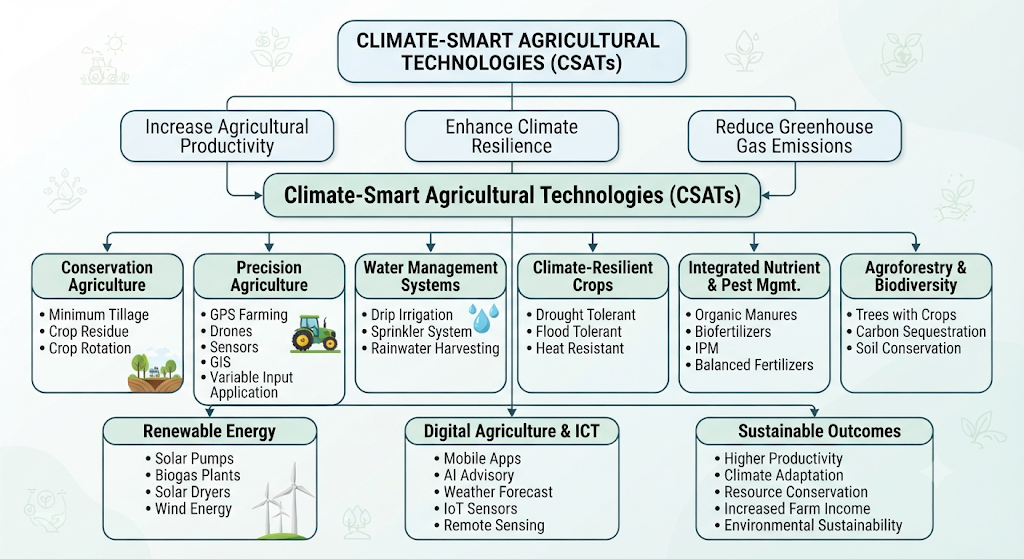
Efficient water management technologies form another critical component of CSA. Drip irrigation, sprinkler irrigation, rainwater harvesting, laser land levelling, and automated irrigation systems significantly improve water-use efficiency while reducing water losses. These technologies are particularly valuable in regions experiencing water scarcity due to climate change. Climate-resilient crop varieties have become increasingly important for maintaining productivity under changing climatic conditions. Drought-tolerant, flood-tolerant, salinity-resistant, and heat-tolerant crop varieties enable farmers to withstand adverse weather events while maintaining stable yields. Modern plant breeding and biotechnology continue to develop improved varieties capable of adapting to diverse environmental stresses. Integrated nutrient management combines organic manures, biofertilizers, compost, crop residues, green manures, and balanced chemical fertilizers to improve soil health and nutrient availability. Similarly, integrated pest management (IPM) promotes biological control agents, resistant varieties, cultural practices, and need-based pesticide application to reduce environmental pollution and pesticide resistance.
Agroforestry systems integrate trees with crops and livestock to enhance biodiversity, improve soil fertility, conserve moisture, and provide additional income through timber, fruits, and fodder. Trees also capture atmospheric carbon dioxide, contributing to climate change mitigation. Digital agriculture has emerged as a transformative component of climate-smart farming. Mobile applications, weather forecasting services, artificial intelligence, Internet of Things (IoT) devices, and decision-support systems provide farmers with real-time information regarding weather conditions, pest outbreaks, market prices, and farm management recommendations. These technologies improve decision-making while reducing production risks. Renewable energy technologies such as solar-powered irrigation pumps, biogas plants, wind energy systems, and solar dryers reduce dependence on fossil fuels while lowering greenhouse gas emissions. These technologies also reduce production costs and improve energy security in rural areas.
The successful implementation of climate-smart agricultural technologies requires supportive policies, effective extension services, research institutions, financial assistance, and active farmer participation. Since farming conditions vary across regions, climate-smart technologies should be adapted according to local climatic, ecological, socio-economic, and cultural conditions. Integrated implementation of these technologies contributes significantly to sustainable agricultural production, improved resilience, enhanced environmental conservation, and long-term food security.
Factors Influencing Farmers' Adoption Behaviour towards Climate-Smart Agricultural Technologies#
Farmers' adoption behaviour towards climate-smart agricultural technologies is a complex decision-making process influenced by multiple interrelated factors. Adoption is not determined solely by the technical superiority of a technology but also by farmers' personal characteristics, economic conditions, institutional support, environmental circumstances, and social interactions. Understanding these determinants is essential for designing effective policies and extension programmes that encourage widespread adoption of climate-smart innovations.
Socio-economic characteristics are among the most significant determinants of adoption behaviour. Education improves farmers' ability to understand new technologies, interpret technical information, and recognize long-term benefits. Educated farmers are generally more willing to experiment with innovative practices and are quicker to adopt improved technologies. Age also influences adoption behaviour, although its impact varies. Younger farmers often exhibit greater willingness to adopt modern technologies due to higher exposure to digital tools and scientific information, whereas experienced older farmers may rely more heavily on traditional farming practices.
Farm size substantially affects adoption decisions. Large-scale farmers generally possess greater financial resources and can absorb the risks associated with new technologies. They often have easier access to machinery, skilled labour, and institutional support. In contrast, smallholder farmers frequently face financial constraints that limit investment in advanced technologies despite recognizing their potential benefits.
Income level and access to agricultural credit significantly influence technology adoption. Many climate-smart technologies require considerable initial investment in equipment, irrigation systems, improved seeds, or digital tools. Affordable credit facilities, low-interest loans, crop insurance, and government subsidies enable farmers to overcome financial barriers and invest confidently in climate-smart practices.
Extension services play a critical role in promoting technology adoption. Agricultural extension personnel provide technical guidance, on-farm demonstrations, farmer field schools, training programmes, and advisory services that increase farmers' awareness and confidence. Frequent interactions between farmers and extension workers improve understanding of technology benefits and encourage successful implementation.
Access to climate information and digital advisory services has become increasingly important. Weather forecasting systems, mobile-based advisory applications, early warning systems, and market information platforms help farmers make informed decisions regarding planting, irrigation, fertilizer application, pest management, and harvesting. Timely access to accurate information reduces uncertainty and increases adoption rates.
Farmers' perception of climate change strongly influences adoption behaviour. Individuals who have personally experienced droughts, floods, heat stress, or declining crop productivity are generally more willing to adopt adaptive technologies. Perceived vulnerability motivates farmers to seek innovative practices that improve resilience against climatic risks.
Social and institutional factors also affect adoption decisions. Membership in farmer producer organizations, cooperatives, self-help groups, and community organizations facilitates information exchange, collective learning, and peer influence. Farmers often adopt technologies after observing successful implementation by neighbouring farmers, demonstrating the importance of social learning and diffusion networks.
Market accessibility influences technology adoption by determining whether increased production can generate higher incomes. Reliable transportation, storage facilities, value chains, and profitable market opportunities encourage farmers to invest in improved technologies. Conversely, weak market infrastructure discourages adoption because farmers remain uncertain about recovering their investments.
Government policies and institutional support are equally important. Subsidies, crop insurance, minimum support prices, climate adaptation programmes, research initiatives, and rural infrastructure development create an enabling environment for climate-smart agriculture. Policy stability and transparent implementation further enhance farmers' confidence in adopting innovative technologies.
Despite these facilitating factors, several constraints continue to hinder adoption, including inadequate technical knowledge, high technology costs, limited access to quality inputs, poor rural infrastructure, fragmented landholdings, labour shortages, and uncertainty regarding long-term technology performance. Addressing these challenges requires integrated efforts involving governments, research organizations, extension agencies, financial institutions, private sector stakeholders, and farming communities. Strengthening institutional support and improving access to information, finance, and markets can significantly accelerate the adoption of climate-smart agricultural technologies and contribute to sustainable agricultural development.
Barriers and Challenges in the Adoption of Climate-Smart Agricultural Technologies#
The adoption of Climate-Smart Agricultural Technologies (CSATs) is essential for enhancing agricultural resilience, improving productivity, and ensuring environmental sustainability. However, despite their proven benefits, the adoption rate among farmers remains uneven across different regions and farming systems. Several socio-economic, institutional, technological, environmental, and psychological barriers limit the widespread acceptance and sustained use of climate-smart technologies. Understanding these challenges is crucial for designing effective interventions that promote sustainable agricultural transformation.
One of the major barriers is the high initial investment cost associated with many climate-smart technologies. Practices such as drip irrigation, sprinkler irrigation, precision farming equipment, solar-powered irrigation systems, drones, sensors, and automated machinery require substantial capital investment. Small and marginal farmers, who constitute the majority of agricultural producers in developing countries, often lack sufficient financial resources to invest in these technologies. Limited savings and restricted access to affordable credit further reduce their capacity to adopt innovative farming practices.
Another significant challenge is the limited availability of institutional credit and insurance services. Financial institutions frequently consider agriculture a high-risk sector due to unpredictable weather conditions and fluctuating market prices. Consequently, many farmers face difficulties obtaining loans with favourable interest rates. Similarly, inadequate crop insurance coverage discourages farmers from adopting new technologies because they fear financial losses if the technologies fail under adverse climatic conditions.
Lack of awareness and technical knowledge is another important constraint. Many farmers are unfamiliar with climate-smart agricultural technologies or do not fully understand their long-term benefits. Inadequate extension services, limited training programmes, and insufficient field demonstrations restrict farmers' access to reliable technical information. Without proper guidance, farmers often continue using conventional farming practices with which they are more familiar.
The complexity of advanced technologies also affects adoption behaviour. Digital agriculture, precision farming, artificial intelligence-based advisory systems, and remote sensing technologies require technical skills and digital literacy. Elderly farmers and those with limited educational backgrounds may find these technologies difficult to understand and operate, resulting in reluctance to adopt them.
Poor rural infrastructure significantly hinders technology adoption. Inadequate irrigation facilities, unreliable electricity supply, poor road connectivity, limited internet access, and insufficient storage infrastructure reduce the effectiveness of many climate-smart technologies. Digital advisory services, for instance, require reliable mobile networks and internet connectivity, which remain inadequate in many rural areas.
Fragmented landholdings present another challenge. Small and scattered farms limit the economic feasibility of mechanization and precision agriculture. Farmers operating on very small plots may find it difficult to justify investing in expensive technologies that generate greater returns on larger farms.
Climate uncertainty itself creates hesitation among farmers. Although climate-smart technologies are designed to reduce climate risks, farmers often remain uncertain about their effectiveness under local conditions. Variability in rainfall patterns, temperature fluctuations, pest outbreaks, and extreme weather events make it difficult for farmers to predict the economic returns of adopting new technologies. This uncertainty increases risk aversion and delays adoption decisions.
Market-related constraints also influence adoption behaviour. Farmers may hesitate to invest in improved technologies if they lack access to profitable markets, fair prices, transportation facilities, or efficient supply chains. Without guaranteed market opportunities, increased production may not translate into higher income, reducing the incentive to adopt climate-smart practices.
Social and cultural factors further affect technology diffusion. Traditional beliefs, resistance to changing long-established farming practices, and dependence on indigenous knowledge sometimes discourage farmers from experimenting with modern technologies. In many rural communities, adoption decisions are influenced by neighbours, family members, and local leaders. If influential community members remain sceptical about new technologies, adoption rates tend to remain low.
Institutional challenges include weak coordination among research organizations, extension agencies, government departments, and private sector stakeholders. Delays in subsidy distribution, inconsistent government policies, inadequate monitoring systems, and limited availability of quality agricultural inputs also reduce farmers' confidence in adopting climate-smart technologies.
Overcoming these barriers requires integrated policy interventions involving improved financial support, strengthened extension services, farmer training programmes, digital literacy initiatives, infrastructure development, and stronger research-extension-farmer linkages. Participatory technology development, localized demonstrations, and community-based climate adaptation programmes can further increase farmers' confidence and accelerate the adoption of climate-smart agricultural technologies.
Strategies for Promoting Farmers' Adoption of Climate-Smart Agricultural Technologies#
The successful adoption of Climate-Smart Agricultural Technologies (CSATs) requires coordinated efforts from governments, research institutions, extension agencies, financial organizations, private companies, and farming communities. Since adoption behaviour is influenced by multiple socio-economic, institutional, technological, and environmental factors, comprehensive strategies are needed to encourage farmers to integrate climate-smart practices into their farming systems. These strategies should focus on improving awareness, accessibility, affordability, technical support, and policy implementation.
One of the most effective strategies is strengthening agricultural extension services. Extension personnel serve as the primary link between research institutions and farmers by disseminating scientific knowledge, demonstrating improved technologies, and providing continuous technical guidance. Regular field demonstrations, farmer field schools, village-level training programmes, and on-farm trials enable farmers to observe the practical benefits of climate-smart technologies before adopting them. Personalized advisory services also help farmers address location-specific production challenges. Capacity building and farmer education are essential for improving technology adoption. Organizing workshops, awareness campaigns, exposure visits, skill development programmes, and climate literacy initiatives enhances farmers' understanding of climate change and sustainable agricultural practices. Educated farmers are more capable of evaluating technological innovations, managing production risks, and making informed decisions regarding resource management. Improving access to affordable financial services is another critical strategy. Governments and financial institutions should provide low-interest agricultural loans, flexible repayment schemes, credit guarantees, and targeted subsidies for climate-smart technologies. Financial assistance reduces investment barriers associated with irrigation systems, precision farming equipment, renewable energy technologies, and improved crop varieties. Crop insurance programmes should also be expanded to protect farmers against climate-related production risks, thereby encouraging investment in innovative technologies. Digital agriculture offers tremendous opportunities to accelerate technology adoption. Mobile applications, artificial intelligence-based advisory platforms, Internet of Things (IoT) devices, weather forecasting systems, remote sensing technologies, and satellite-based monitoring provide real-time information that supports farm decision-making. Farmers can receive recommendations on irrigation scheduling, pest management, fertilizer application, weather forecasts, and market prices directly through smartphones. Expanding digital infrastructure and improving rural internet connectivity are therefore essential for promoting climate-smart agriculture. The development and dissemination of locally adapted climate-smart technologies significantly improve adoption rates. Agricultural research institutions should develop technologies suitable for different agro-climatic zones, soil types, cropping systems, and socio-economic conditions. Participatory research involving farmers in technology development ensures that innovations address practical farming challenges while increasing farmers' confidence in their effectiveness. Farmer Producer Organizations (FPOs), cooperatives, and self-help groups play an important role in promoting collective adoption. These organizations facilitate knowledge sharing, group training, bulk purchasing of inputs, collective marketing, and easier access to government schemes. Farmers are often more willing to adopt new technologies after observing successful implementation by fellow group members.
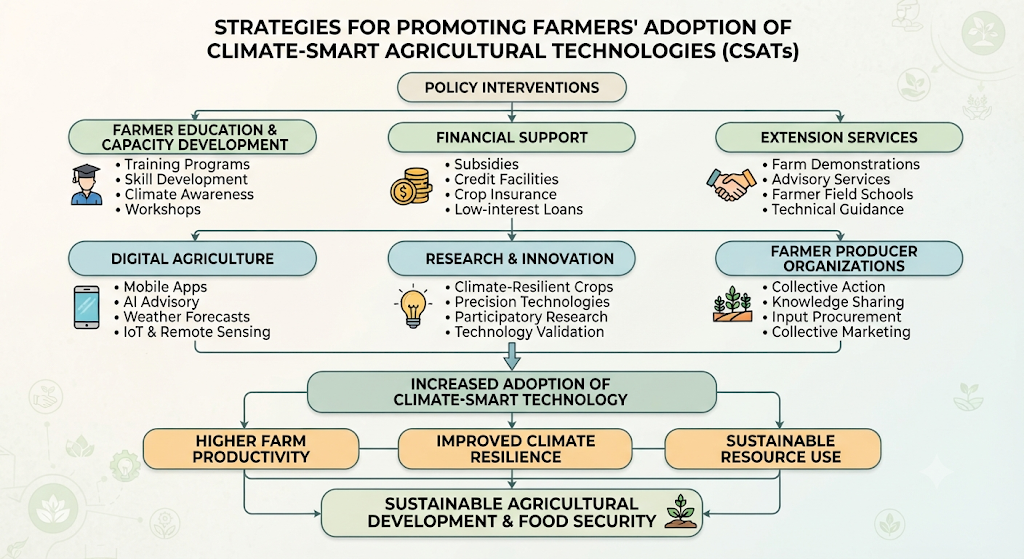
Government policies provide the foundation for widespread climate-smart agriculture. Policy measures should include subsidies for water-saving technologies, renewable energy systems, climate-resilient seeds, precision farming equipment, and conservation agriculture practices. Incentives for carbon sequestration, sustainable land management, and resource conservation can further motivate farmers to adopt environmentally friendly technologies. Long-term policy stability enhances investor confidence and encourages private sector participation.
Infrastructure development is equally important. Improving irrigation facilities, rural roads, electricity supply, storage structures, digital connectivity, and market infrastructure enhances the practical feasibility of adopting climate-smart technologies. Efficient supply chains ensure timely availability of quality seeds, fertilizers, machinery, and technical services.
Public-private partnerships can strengthen technology dissemination by combining government support with private-sector innovation. Agribusiness companies, technology firms, non-governmental organizations, and research institutions can collaborate to develop affordable climate-smart solutions and expand extension services through digital platforms.
Finally, continuous monitoring, impact assessment, and policy evaluation are essential for ensuring the long-term success of climate-smart agriculture programmes. Feedback from farmers should be incorporated into programme design to improve implementation efficiency. By integrating education, financial support, digital innovation, infrastructure development, institutional coordination, and participatory approaches, governments and stakeholders can significantly increase farmers' adoption of climate-smart agricultural technologies, thereby promoting sustainable agricultural development, climate resilience, food security, and environmental conservation.
Conclusion#
Climate change has become one of the most pressing challenges confronting global agriculture, threatening food security, natural resource sustainability, and the livelihoods of millions of farming households. Rising temperatures, erratic rainfall patterns, prolonged droughts, floods, and the increasing frequency of extreme weather events have significantly affected agricultural productivity and rural economies. In response to these challenges, Climate-Smart Agricultural Technologies (CSATs) have emerged as sustainable solutions that simultaneously enhance agricultural productivity, strengthen climate resilience, and contribute to environmental conservation. However, the long-term success of these technologies depends not only on their technical effectiveness but also on farmers' willingness and ability to adopt them.
Farmers' adoption behaviour is a multidimensional process influenced by a combination of socio-economic, technological, institutional, psychological, and environmental factors. Variables such as education, farming experience, landholding size, income level, access to credit, extension services, climate awareness, market opportunities, and government support significantly shape farmers' decisions regarding technology adoption. In addition, personal attitudes toward innovation, perceived risks, expected economic returns, and social influence from neighbouring farmers or community organizations also affect the adoption process. Therefore, technology adoption should be viewed as a behavioural and social process rather than merely a technical decision.
The study highlights that climate-smart agricultural technologies provide numerous advantages for sustainable farming. Conservation agriculture, precision farming, efficient irrigation systems, climate-resilient crop varieties, integrated nutrient management, agroforestry, renewable energy applications, and digital advisory services improve resource-use efficiency, reduce production costs, increase productivity, and strengthen resilience against climatic uncertainties. These technologies also contribute to soil conservation, water management, biodiversity protection, and greenhouse gas mitigation, thereby supporting the broader goals of sustainable development and climate adaptation.
Despite these benefits, several barriers continue to limit widespread adoption. High investment costs, inadequate access to affordable credit, weak extension systems, poor rural infrastructure, fragmented landholdings, limited technical knowledge, low digital literacy, and uncertain market conditions discourage many farmers from investing in innovative technologies. Small and marginal farmers are particularly vulnerable because they often lack the financial resources and institutional support necessary to implement climate-smart practices. Furthermore, inconsistent policy implementation, insufficient research-extension coordination, and limited availability of location-specific technologies further slow the diffusion of climate-smart innovations.
To overcome these challenges, coordinated efforts among governments, research institutions, extension agencies, financial organizations, private enterprises, and farming communities are essential. Strengthening agricultural extension services through regular training, field demonstrations, farmer field schools, and digital advisory platforms can significantly improve farmers' awareness and technical competence. Expanding access to affordable credit, crop insurance, and targeted subsidies will reduce financial barriers associated with technology adoption. Investments in rural infrastructure, internet connectivity, irrigation facilities, and market development will further create an enabling environment for sustainable agricultural transformation.
The increasing role of digital agriculture presents new opportunities for accelerating technology adoption. Artificial intelligence, remote sensing, Internet of Things (IoT), mobile advisory services, satellite-based weather forecasting, and precision agriculture can provide farmers with timely information for efficient farm management and climate adaptation. At the same time, participatory research approaches that involve farmers in technology development and evaluation ensure that innovations are better suited to local farming conditions and socio-economic realities.
In conclusion, promoting farmers' adoption behaviour towards climate-smart agricultural technologies is fundamental for achieving sustainable agricultural development under changing climatic conditions. Successful adoption requires an integrated approach that combines scientific innovation, supportive public policies, financial inclusion, institutional strengthening, effective extension services, and community participation. By addressing existing barriers and creating favourable conditions for technology diffusion, governments and stakeholders can empower farmers to build resilient, productive, and environmentally sustainable farming systems. Widespread adoption of climate-smart agricultural technologies will not only improve agricultural productivity and farm incomes but will also contribute significantly to national food security, natural resource conservation, climate resilience, and the achievement of global Sustainable Development Goals (SDGs).
Works Cited#
- Birthal, P. S., Roy, D., & Negi, D. S. (2015). Assessing the impact of crop diversification on farm poverty in India. World Development, 72, 70–92.
- FAO. (2013). Climate-smart agriculture sourcebook. Food and Agriculture Organization of the United Nations, Rome.
- FAO. (2017). Climate-smart agriculture: Policies, practices and financing for food security, adaptation and mitigation. Food and Agriculture Organization of the United Nations.
- Intergovernmental Panel on Climate Change (IPCC). (2022). Climate Change 2022: Impacts, Adaptation and Vulnerability. Cambridge University Press.
- Knowler, D., & Bradshaw, B. (2007). Farmers' adoption of conservation agriculture: A review and synthesis of recent research. Food Policy, 32(1), 25–48.
- Lal, R. (2020). Regenerative agriculture for food and climate. Journal of Soil and Water Conservation, 75(5), 123A–124A.
- Meijer, S. S., Catacutan, D., Sileshi, G. W., & Nieuwenhuis, M. (2015). The role of knowledge, attitudes and perceptions in the adoption of agricultural technologies. International Journal of Agricultural Sustainability, 13(1), 40–54.
- Mottaleb, K. A. (2018). Perception and adoption of climate-smart agriculture in developing countries. Sustainability, 10(12), 4204.
- OECD. (2019). Innovation, Agricultural Productivity and Sustainability in India. OECD Publishing, Paris.
- Pannell, D. J., Marshall, G. R., Barr, N., Curtis, A., Vanclay, F., & Wilkinson, R. (2006). Understanding and promoting adoption of conservation technologies by rural landholders. Australian Journal of Experimental Agriculture, 46(11), 1407–1424.
- Pretty, J. (2018). Intensification for redesigned and sustainable agricultural systems. Science, 362(6417), eaav0294.
- Rogers, E. M. (2003). Diffusion of Innovations (5th ed.). Free Press.
- Rose, D. C., Sutherland, W. J., Parker, C., et al. (2016). Decision support tools for agriculture: Towards effective design and delivery. Agricultural Systems, 149, 165–174.
- Sahu, N. C., & Mishra, D. (2020). Farmers' adaptation to climate change in India. Climate and Development, 12(2), 123–135.
- Singh, R., & Singh, G. S. (2017). Traditional agriculture: A climate-smart approach for sustainable food production. Energy, Ecology and Environment, 2(5), 296–316.
- Thornton, P. K., & Lipper, L. (2014). How does climate change alter agricultural strategies? Global Food Security, 2(4), 197–201.
- United Nations. (2015). Transforming our world: The 2030 Agenda for Sustainable Development. United Nations.
- World Bank. (2021). Climate-Smart Agriculture. World Bank Publications.
- World Bank. (2023). Recipe for a Livable Planet: Achieving Net Zero Emissions in the Agrifood System. World Bank.
- Yadav, S. S., McDonald, G. K., & Redden, R. (2019). Climate Change and Management of Cool Season Grain Legume Crops. Springer Nature