Abstract
The present study examines the contribution of civil society organizations in strengthening democratic values, protecting rights, and improving community development. Civil society organizations include non-governmental organizations, community-based organizations, self-help groups, voluntary associations, social movements, welfare societies, advocacy groups, and people’s collectives that work for public welfare outside direct government control.
- Civil Society Organizations
- Social Justice
- Community Empowerment
- Participatory Governance
- Non-Governmental Organizations
- Community Development
- Social Inclusion
- Democratic Participation
- Advocacy
- Accountability
Introduction#
Civil society organizations play an important role in the social, political, and developmental life of a country. They work as a link between citizens, communities, government institutions, and development agencies. Civil society organizations include non-governmental organizations, voluntary groups, self-help groups, community-based organizations, social movements, charitable trusts, advocacy groups, professional associations, and people’s collectives. These organizations generally work for public welfare, rights protection, social awareness, community development, and democratic participation.
Social justice is one of the major goals of civil society organizations. Social justice means fairness, equality, dignity, and equal opportunity for all sections of society. In many societies, people face discrimination due to poverty, caste, gender, religion, disability, age, ethnicity, migration status, or social background. Civil society organizations raise their voice against such discrimination and work for the rights of marginalized and vulnerable groups. They create awareness about legal rights, constitutional values, human rights, social welfare schemes, education, healthcare, livelihood, and protection from exploitation.
Community empowerment is another important area in which civil society organizations contribute. Empowerment means enabling people to understand their rights, develop confidence, improve skills, participate in decision-making, and take control of their own development. Civil society organizations organize training programmes, awareness camps, literacy drives, health campaigns, livelihood activities, self-help groups, and leadership development programmes. These activities help people become more self-reliant, informed, and active in community life.
Civil society organizations also promote participatory governance. Participatory governance means involving citizens and communities in planning, decision-making, implementation, and monitoring of policies and development programmes. In many cases, government schemes may not reach people effectively due to lack of awareness, corruption, poor implementation, or weak communication. Civil society organizations help bridge this gap by informing people about schemes, collecting community feedback, monitoring services, and demanding transparency and accountability.
These organizations are especially important for marginalized communities. Poor families, women, children, elderly persons, persons with disabilities, migrants, tribal groups, minorities, and socially excluded communities often lack access to institutions and decision-making platforms. Civil society organizations help such groups express their needs, organize collectively, and claim their rights. They also provide support in education, healthcare, legal aid, employment, sanitation, environmental protection, and social security.
In democratic societies, civil society organizations strengthen public participation. Democracy is not limited to elections; it also requires active citizenship, public debate, social responsibility, and accountability of institutions. Civil society organizations encourage citizens to participate in local governance, gram sabhas, municipal meetings, public hearings, social audits, awareness campaigns, and community development activities. Through these efforts, people become active participants rather than passive beneficiaries.
Civil society organizations also act as watchdogs. They monitor government policies, public services, budget use, welfare delivery, environmental protection, and human rights conditions. By raising public issues, conducting research, filing petitions, organizing campaigns, and engaging with media, they help make governance more transparent and accountable. This role is important for reducing corruption, improving service delivery, and protecting democratic rights.
However, civil society organizations also face challenges. These include shortage of funds, dependence on donors, limited trained staff, political pressure, lack of coordination, weak community participation, and administrative restrictions. Some organizations may also face trust issues if transparency and accountability are not maintained within their own functioning. Therefore, civil society organizations must follow ethical practices, community-based planning, proper documentation, and transparent management. The present study is significant because it highlights the contribution of civil society in building an inclusive and democratic society. It shows that development becomes more meaningful when people participate actively and when vulnerable groups are given voice, dignity, and opportunity.
Conceptual Framework and Evolution of Civil Society Organizations#
Civil society organizations are important institutions in modern society because they work between the state, market, and citizens. They represent the collective efforts of people who come together voluntarily to address social issues, protect rights, promote welfare, and strengthen democratic participation. Civil society organizations include non-governmental organizations, voluntary associations, community-based organizations, self-help groups, charitable trusts, advocacy groups, social movements, professional associations, faith-based organizations, cooperatives, and people’s collectives.
The concept of civil society is based on the idea that citizens should not remain dependent only on the government for solving social problems. People also have the responsibility and capacity to organize themselves and work for the common good. Civil society provides a space where individuals and communities can express their needs, raise concerns, demand justice, and participate in development activities. It encourages active citizenship and strengthens democratic values.
Civil society organizations are generally non-state and non-profit in nature. They do not function mainly for commercial profit or direct political power. Their purpose is usually public welfare, community development, rights protection, service delivery, awareness generation, social reform, or advocacy. However, their work may influence public policy and governance because they raise public issues and represent community voices.
The conceptual framework of civil society organizations includes three major dimensions: service delivery, advocacy, and empowerment. Service delivery refers to providing direct support such as education, healthcare, relief work, legal aid, skill training, shelter, food, and livelihood assistance. Advocacy means raising awareness, influencing policy, demanding rights, and challenging injustice. Empowerment means enabling communities to become aware, organized, confident, and capable of participating in decision-making.
Civil society organizations also act as a bridge between citizens and government institutions. Many marginalized groups may not have direct access to government offices, welfare schemes, courts, schools, hospitals, or decision-making platforms. Civil society organizations help such groups understand their rights, access services, file complaints, form groups, and participate in local governance. In this way, they reduce the gap between people and institutions.
The evolution of civil society organizations has a long history. In traditional societies, community groups, religious institutions, caste associations, village councils, charity groups, and mutual aid systems performed many functions that are now associated with civil society. These groups supported poor people, organized community activities, settled disputes, preserved culture, and provided social assistance during crises.
During the colonial period in many countries, civil society activities became linked with social reform, education, health, women’s rights, abolition of social evils, and national awakening. Reformers and voluntary groups worked to spread literacy, improve public health, challenge discrimination, and promote social consciousness. Civil society also played an important role in freedom movements by mobilizing people, spreading awareness, and encouraging collective action.
After independence in many emerging societies, civil society organizations expanded their role in development. Governments introduced welfare schemes and development programmes, but many rural and marginalized communities remained outside their full benefit. Civil society organizations helped implement development activities in areas such as education, healthcare, rural development, poverty reduction, sanitation, women’s empowerment, and child welfare.
In the late twentieth century, civil society organizations became more active in rights-based movements. They started working not only as charity providers but also as advocates for justice, equality, participation, and accountability. Movements related to environment, gender justice, labour rights, tribal rights, disability rights, consumer rights, human rights, and transparency increased the importance of civil society in democratic governance.
Globalization and technological development further changed the role of civil society organizations. Today, they use digital platforms, social media, online campaigns, research reports, public interest litigation, community mobilization, and international networks to raise social issues. Their reach has expanded from local communities to national and global platforms. Civil society organizations now participate in debates on climate change, migration, digital rights, public health, education, poverty, and sustainable development.
The evolution of civil society organizations also shows a shift from welfare-based work to participatory development. Earlier, many organizations focused mainly on providing charity or relief. Gradually, the focus shifted toward helping people become self-reliant and active participants in development. This includes forming self-help groups, training local leaders, encouraging women’s participation, supporting social audits, and promoting community ownership of development programmes.
Civil society organizations perform several important functions. They identify local problems, mobilize community participation, create awareness, provide services, monitor government schemes, support marginalized groups, conduct research, influence policy, and promote social change. They also help build trust, cooperation, and solidarity among people. In crisis situations such as floods, pandemics, earthquakes, conflicts, and displacement, civil society organizations often provide quick relief and rehabilitation support.
The theoretical understanding of civil society is also important. From a democratic perspective, civil society is seen as a space for citizen participation and public debate. From a development perspective, it is viewed as a partner in welfare delivery and community empowerment. From a rights-based perspective, civil society is seen as a force that challenges injustice and demands accountability. These perspectives together show that civil society organizations are essential for both social development and democratic deepening.
In modern governance, civil society organizations are increasingly recognized as partners of the state. Governments alone cannot address all social problems, especially in large and diverse societies. Civil society organizations often have closer contact with local communities and better understanding of ground realities. Therefore, collaboration between government and civil society can improve policy implementation, service delivery, awareness, and public participation.
However, civil society organizations also face challenges. They may suffer from lack of funds, shortage of trained workers, donor dependency, political pressure, legal restrictions, weak internal management, and limited accountability. Some organizations may also become disconnected from communities if they focus more on projects than people’s real needs. Therefore, transparency, ethical functioning, community participation, and accountability are necessary for maintaining public trust.
In conclusion, civil society organizations have evolved from traditional charity and community support systems into important actors of social justice, development, empowerment, and governance. Their conceptual foundation lies in voluntary action, public welfare, democratic participation, and community responsibility. They provide voice to marginalized groups, promote rights, strengthen communities, and support inclusive governance. Thus, understanding the conceptual framework and evolution of civil society organizations is essential for analyzing their role in social justice, community empowerment, and participatory governance.
Role of Civil Society Organizations in Promoting Social Justice#
Civil society organizations play a very important role in promoting social justice in society. Social justice means fairness, equality, dignity, protection of rights, and equal access to opportunities for all people. In every society, some groups face discrimination, poverty, exclusion, and lack of access to basic services. These groups may include women, children, elderly persons, persons with disabilities, scheduled castes, tribal communities, minorities, migrants, labourers, homeless persons, and people living in remote areas. Civil society organizations work to support these vulnerable sections and help them claim their rights.
One of the major roles of civil society organizations is awareness generation. Many marginalized people are not fully aware of their constitutional rights, legal protections, government schemes, welfare benefits, and social entitlements. Civil society organizations organize awareness camps, community meetings, workshops, rallies, street plays, training programmes, and public campaigns to inform people about their rights. Awareness helps people understand that education, healthcare, livelihood, dignity, safety, and equality are not charity but basic rights.
Civil society organizations also work against discrimination and social inequality. Discrimination based on caste, gender, religion, disability, poverty, age, language, ethnicity, or occupation prevents many people from participating equally in social life. Civil society organizations raise their voice against such injustice and support the victims of discrimination. They may provide counselling, legal aid, documentation support, advocacy, and community mobilization. Through these efforts, they help build a more equal and inclusive society.
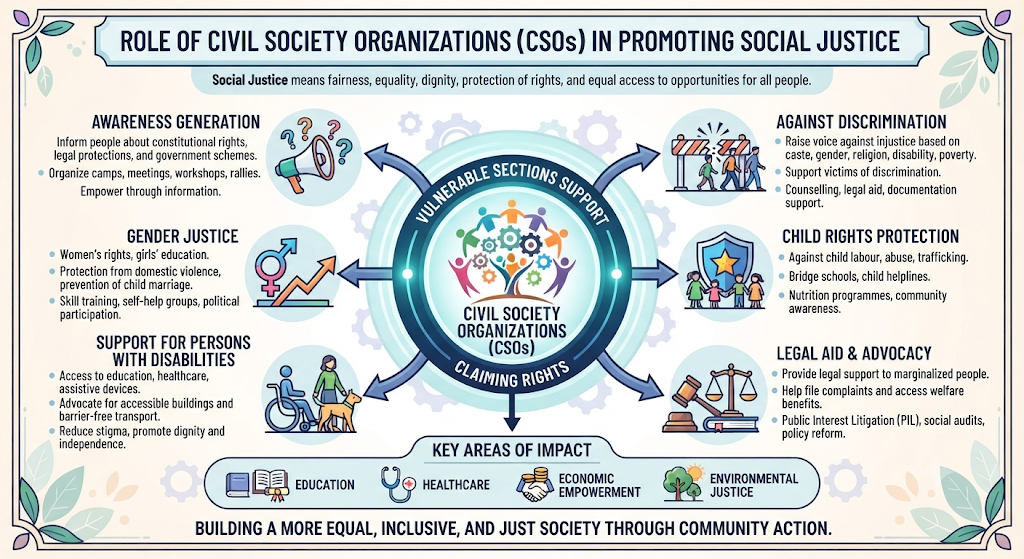
Gender justice is an important area of civil society work. Many organizations work for women’s rights, girls’ education, protection from domestic violence, prevention of child marriage, livelihood opportunities, health awareness, and political participation. They form women’s self-help groups, provide skill training, support legal awareness, and encourage women to become active decision-makers in family and community life. These efforts promote dignity, confidence, and empowerment among women.
Civil society organizations also protect the rights of children. They work against child labour, child marriage, child abuse, trafficking, malnutrition, school dropout, and denial of education. Many organizations support bridge schools, child helplines, counselling services, nutrition programmes, and community awareness for child protection. By working with families, schools, and local authorities, civil society organizations help create safer and more supportive environments for children.
Another important role is support for persons with disabilities. Civil society organizations help persons with disabilities access education, healthcare, assistive devices, skill training, employment opportunities, and legal rights. They also advocate for accessible buildings, inclusive education, barrier-free transport, and equal participation. Their work helps reduce stigma and promotes dignity and independence.
Civil society organizations also support social justice through legal aid and rights-based advocacy. Poor and marginalized people often cannot afford legal support or do not know how to approach institutions. Civil society organizations help them file complaints, access legal services, obtain identity documents, and claim welfare benefits. They may also support public interest litigation, social audits, policy reform, and campaigns for justice.
In the field of education, civil society organizations promote social justice by helping disadvantaged children access schooling. They provide scholarships, remedial classes, learning materials, community libraries, digital education support, and enrolment drives. They also work to reduce dropout rates among girls, migrant children, children with disabilities, and children from poor families. Equal access to education is one of the strongest tools for reducing inequality.
In healthcare, civil society organizations work to improve access for poor and marginalized communities. They organize health camps, vaccination drives, nutrition programmes, sanitation awareness, maternal and child health services, mental health support, and disease-prevention campaigns. They also help communities access public health schemes and raise concerns about poor healthcare delivery. Health justice is important because poor health often increases poverty and exclusion.
Civil society organizations also promote economic justice. They support livelihood generation, skill development, self-employment, microfinance, self-help groups, farmer collectives, labour rights, and income-generation programmes. By helping people become economically stronger, they reduce dependency and improve social dignity. Economic empowerment is closely connected with social justice because people with livelihood security can participate more confidently in society.
Environmental justice is another growing area of civil society work. Poor and marginalized communities are often most affected by pollution, displacement, water scarcity, climate change, deforestation, and industrial projects. Civil society organizations raise awareness about environmental rights, protect natural resources, support sustainable livelihoods, and advocate for affected communities.
Contribution of Civil Society Organizations to Community Empowerment#
Civil society organizations play a significant role in community empowerment by helping people become aware, confident, organized, skilled, and capable of participating in their own development. Community empowerment means strengthening the ability of people to identify their problems, understand their rights, use available resources, participate in decision-making, and improve their social and economic conditions. It is not merely about providing help to people; it is about enabling people to help themselves and take control of their lives.
One of the major contributions of civil society organizations is awareness generation. Many communities, especially poor and marginalized groups, are not fully aware of their rights, government schemes, legal protections, educational opportunities, healthcare services, and livelihood programmes. Civil society organizations organize awareness camps, public meetings, workshops, street plays, training sessions, and door-to-door campaigns to educate people. This awareness helps communities understand that they are entitled to dignity, justice, equality, and development opportunities.
Civil society organizations also promote community participation. Development becomes meaningful only when people are actively involved in planning and implementation. CSOs encourage local people to attend gram sabhas, community meetings, public hearings, school management committees, health committees, and local governance platforms. Through participation, people learn to express their needs, ask questions, monitor services, and influence decisions affecting their lives.
Capacity building is another important contribution of civil society organizations. Capacity building means developing knowledge, skills, leadership qualities, and confidence among community members. CSOs conduct training programmes on health, education, sanitation, financial literacy, legal awareness, digital literacy, entrepreneurship, agriculture, environment, and governance. These trainings help people become more capable of solving local problems and using available opportunities.
Women’s empowerment is one of the strongest areas of civil society work. Many civil society organizations form self-help groups, women’s collectives, savings groups, and livelihood groups. These groups help women save money, access credit, start small businesses, learn skills, and participate in community decisions. Women who were earlier dependent or silent often become confident and active through such initiatives. Empowered women contribute not only to family welfare but also to community development.
Civil society organizations also support youth empowerment. Youth are important agents of social change, but they often need guidance, skills, and opportunities. CSOs organize skill-development programmes, career guidance, sports activities, leadership training, digital literacy sessions, anti-drug campaigns, environmental drives, and volunteer programmes for youth. Such activities help young people develop responsibility, confidence, discipline, and social commitment.
Livelihood promotion is a key aspect of community empowerment. Poor communities often depend on irregular income, low-paid labour, or informal work. Civil society organizations provide skill training, vocational education, microfinance support, market linkage, entrepreneurship guidance, and employment information. These efforts help people improve income, reduce dependency, and achieve economic self-reliance.
Civil society organizations also promote empowerment through education. They support school enrolment, adult literacy, remedial teaching, bridge courses, digital learning, scholarships, and community libraries. Education increases awareness, confidence, employability, and social mobility. When children and adults gain education, the entire community becomes stronger.
Health empowerment is another important contribution. CSOs organize health camps, nutrition awareness, maternal and child health programmes, sanitation drives, mental health counselling, vaccination awareness, and disease-prevention campaigns. They help communities understand preventive healthcare and access public health services. A healthy community is more capable of participating in development activities.
Civil society organizations also strengthen local leadership. They identify active community members and train them to become local leaders, volunteers, health workers, education motivators, women leaders, and youth leaders. Local leadership is important because development should not depend only on outside agencies. When local people lead initiatives, programmes become more sustainable.
Empowerment also includes social confidence and collective identity. Many marginalized communities feel powerless due to poverty, discrimination, and lack of institutional access. CSOs help them organize collectively and raise their voice. Collective organization gives people strength to demand better schools, roads, water supply, healthcare, ration services, housing, employment, and protection from exploitation.
Community empowerment also involves building trust and cooperation among people. Civil society organizations often bring together different groups within a community to work on common issues. This reduces social distance and strengthens unity. Through collective action, communities learn cooperation, responsibility, and mutual support.
CSOs also help communities access government welfare schemes. Many people are eligible for pensions, scholarships, housing schemes, health insurance, employment schemes, ration benefits, or skill programmes but do not receive them due to lack of documents or awareness. Civil society organizations help with documentation, applications, grievance redressal, and follow-up with authorities.
Another important contribution is empowerment through advocacy. Civil society organizations do not only provide services; they also help communities demand structural changes. They raise issues related to land rights, labour rights, gender justice, disability rights, education rights, health rights, and environmental protection. This helps communities move from passive dependence to active citizenship.
Technology-based empowerment is also becoming important. CSOs help people use digital tools for banking, education, telemedicine, online applications, grievance portals, and information access. Digital literacy helps communities reduce dependency on middlemen and participate more effectively in modern systems.
However, community empowerment through civil society organizations also faces challenges. These include lack of funds, limited trained staff, weak participation, local power politics, social resistance, and dependency on external agencies. Sometimes communities may expect only material benefits and may not participate actively. Therefore, CSOs must focus on long-term empowerment rather than short-term relief.
Civil Society Organizations and Participatory Governance#
Civil society organizations play an important role in promoting participatory governance. Participatory governance means active involvement of citizens and communities in planning, decision-making, implementation, monitoring, and evaluation of public policies and development programmes. It is based on the idea that people should not remain passive recipients of government schemes; they should actively participate in decisions that affect their lives. Civil society organizations act as a bridge between the government and the people. Many citizens, especially poor and marginalized groups, may not know how to approach government offices, access welfare schemes, file complaints, or participate in local governance. Civil society organizations help people understand procedures, prepare documents, attend meetings, and communicate their needs to authorities. One important contribution of civil society organizations is promoting public participation in local governance. They encourage people to attend gram sabhas, municipal meetings, school management committee meetings, health committee meetings, public hearings, and social audits. Through such participation, communities can raise issues related to water, sanitation, roads, schools, hospitals, ration, housing, employment, and social security.
Civil society organizations also strengthen transparency and accountability. They monitor public schemes, check whether benefits are reaching the right people, and raise questions about delays, corruption, poor quality work, or misuse of funds. Social audits, community monitoring, public reports, and awareness campaigns are important tools used by civil society organizations to make governance more accountable.
In participatory governance, information plays a key role. Civil society organizations help people access information about laws, rights, government schemes, budgets, entitlements, and complaint mechanisms. When people have proper information, they can question authorities and demand better services. This strengthens democratic participation and reduces dependence on middlemen.
Civil society organizations also support marginalized communities in governance processes. Women, persons with disabilities, migrants, minorities, tribal communities, and poor households are often excluded from decision-making. CSOs help these groups organize collectively, speak in public meetings, form community groups, and represent their concerns before local authorities. This makes governance more inclusive.
Another important role of civil society organizations is policy advocacy. They collect field-level experiences, document community problems, conduct research, and present recommendations to policymakers. By doing so, they help ensure that policies reflect the real needs of people. Advocacy may focus on education, healthcare, livelihood, gender justice, environment, disability rights, child protection, labour rights, and social security.
Civil society organizations also promote community-based monitoring of public services. For example, they may help communities monitor school attendance, quality of mid-day meals, functioning of health centres, availability of medicines, sanitation services, ration distribution, and implementation of welfare schemes. This improves service delivery and strengthens public trust.
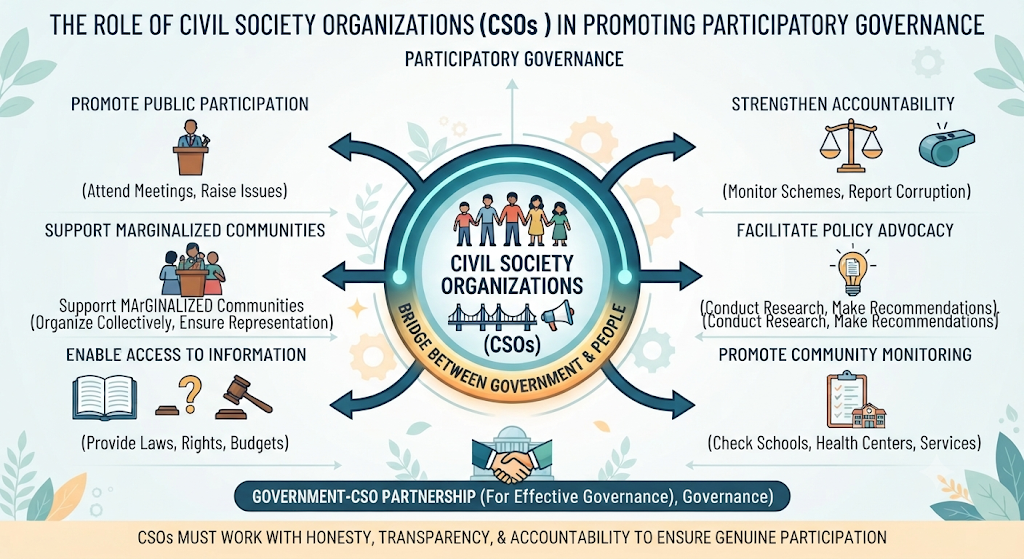
Participatory governance also requires partnership between government and civil society. Government institutions may have resources and authority, while civil society organizations may have grassroots knowledge and community trust. When both work together, development programmes can become more effective, inclusive, and responsive. However, participatory governance faces many challenges. Some communities may lack awareness or confidence to participate. Local power structures may silence poor and marginalized groups. Bureaucratic attitudes, political pressure, lack of transparency, and weak grievance systems may also limit participation. Civil society organizations themselves may face funding shortages, legal restrictions, and administrative challenges. To strengthen participatory governance, civil society organizations must work with honesty, transparency, and accountability. They should ensure that community participation is genuine and not only symbolic. They must encourage local leadership and help communities become self-reliant in dealing with governance issues.
Conclusion#
The study concludes that civil society organizations play a vital role in promoting social justice, community empowerment, and participatory governance in contemporary societies. As voluntary and non-profit institutions, civil society organizations serve as an important link between the state and citizens, particularly for marginalized and vulnerable populations who often remain excluded from mainstream development processes. Their contribution extends beyond welfare activities to include advocacy, awareness generation, rights protection, community mobilization, and democratic participation.
Civil society organizations significantly contribute to social justice by addressing inequality, discrimination, poverty, and exclusion. Through awareness campaigns, legal aid, advocacy initiatives, and community-based interventions, they empower disadvantaged groups to claim their rights and access essential services such as education, healthcare, livelihood opportunities, and social security. Their efforts help create a more inclusive society based on equality, dignity, and human rights.
The study further reveals that community empowerment is one of the most significant contributions of civil society organizations. By promoting awareness, capacity building, leadership development, women's empowerment, youth participation, livelihood enhancement, and local institution strengthening, these organizations enable communities to become active agents of their own development. Empowered communities are better equipped to identify their needs, solve local problems, and participate meaningfully in social and economic activities.
Civil society organizations also strengthen participatory governance by encouraging citizen involvement in decision-making, monitoring public services, ensuring transparency, and demanding accountability from institutions. Through social audits, public hearings, advocacy campaigns, and community participation platforms, they help make governance more responsive, transparent, and people-centered. Their role is particularly important in ensuring that the voices of marginalized communities are represented in policy formulation and implementation.
However, the study also recognizes that civil society organizations face several challenges, including inadequate financial resources, donor dependency, shortage of trained personnel, political pressures, administrative restrictions, and issues related to sustainability and accountability. Addressing these challenges requires supportive policies, stronger institutional capacity, transparent functioning, and effective collaboration among governments, civil society organizations, and communities.
Overall, the study concludes that sustainable and inclusive development cannot be achieved through governmental efforts alone. Active participation of civil society organizations is essential for strengthening democracy, promoting social inclusion, empowering communities, and ensuring accountable governance. Therefore, civil society organizations must be recognized and supported as indispensable partners in building a just, equitable, participatory, and democratic society.
Works Cited#
- Almond, Gabriel A., and Sidney Verba. The Civic Culture: Political Attitudes and Democracy in Five Nations. Princeton University Press, 1963.
- Chambers, Robert. Rural Development: Putting the Last First. Routledge, 1983.
- Cohen, Jean L., and Andrew Arato. Civil Society and Political Theory. MIT Press, 1992.
- Diamond, Larry. “Rethinking Civil Society: Toward Democratic Consolidation.” Journal of Democracy, vol. 5, no. 3, 1994, pp. 4–17.
- Edwards, Michael. Civil Society. 4th ed., Polity Press, 2019.
- Etzioni, Amitai. The Spirit of Community: Rights, Responsibilities, and the Communitarian Agenda. Crown Publishers, 1993.
- Fowler, Alan. Striking a Balance: A Guide to Enhancing the Effectiveness of Non-Governmental Organisations in International Development. Earthscan, 1997.
- Gramsci, Antonio. Selections from the Prison Notebooks. Edited and translated by Quintin Hoare and Geoffrey Nowell Smith, International Publishers, 1971.
- Habermas, Jürgen. The Structural Transformation of the Public Sphere. MIT Press, 1989.
- Korten, David C. Getting to the 21st Century: Voluntary Action and the Global Agenda. Kumarian Press, 1990.
- Lewis, David. Non-Governmental Organizations, Management and Development. Routledge, 2007.
- Lewis, David, and Nazneen Kanji. Non-Governmental Organizations and Development. Routledge, 2009.
- Mansuri, Ghazala, and Vijayendra Rao. Localizing Development: Does Participation Work? World Bank, 2013.
- Narayan, Deepa, editor. Empowerment and Poverty Reduction: A Sourcebook. World Bank, 2002.
- Putnam, Robert D. Bowling Alone: The Collapse and Revival of American Community. Simon & Schuster, 2000.
- Sen, Amartya. Development as Freedom. Oxford University Press, 1999.
- Tandon, Rajesh, and Ranjita Mohanty, editors. Civil Society and Governance. Samskriti, 2003.
- United Nations Development Programme. Governance for Sustainable Human Development. UNDP, 1997.
"Impact of Gamification-Based Learning Strategies on Student Engagement, Motivation, and Academic Performance