Abstract
The present study examines the role of community participation and local governance in achieving sustainable rural development and social inclusion. Rural development becomes more effective when local people actively participate in planning, decision-making, implementation, and monitoring of development programmes. Community participation strengthens ownership, accountability, cooperation, and proper use of local resources. Local governance institutions such as Panchayati Raj bodies, village committees, self-help groups, and community-based organizations play a vital role in identifying local needs and delivering basic services. The study explores how participatory governance supports livelihood generation, infrastructure development, education, health, sanitation, women empowerment, environmental conservation, and inclusion of marginalized groups. It also highlights challenges such as lack of awareness, political interference, unequal participation, limited capacity, and weak institutional coordination. The study concludes that sustainable rural development and social inclusion can be achieved through active citizen participation, transparent governance, decentralized planning, and inclusive decision-making.
- Community Participation
- Local Governance
- Sustainable Rural Development
- Social Inclusion
- Panchayati Raj
- Decentralization
- Rural Empowerment
Introduction#
Community participation and local governance are essential components of sustainable rural development and social inclusion. Rural development cannot be achieved only through top-down policies or government schemes; it requires the active involvement of local people in identifying needs, planning development activities, implementing programmes, and monitoring outcomes. When rural communities participate in development processes, programmes become more relevant, transparent, accountable, and sustainable.
Community participation refers to the involvement of local people in decision-making and development activities that affect their lives. It includes participation in village meetings, Gram Sabha discussions, self-help groups, local committees, social audits, awareness campaigns, and collective action. Community participation allows villagers to express their needs, share local knowledge, contribute resources, and monitor the use of public funds. It creates a sense of ownership and responsibility among citizens.
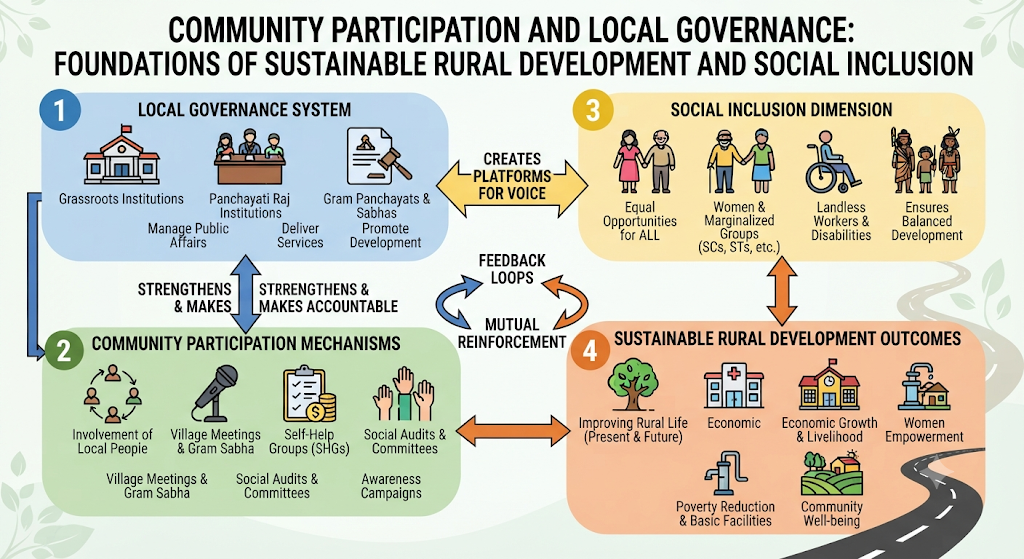
Local governance refers to the system through which local institutions manage public affairs, deliver services, and promote development at the grassroots level. In rural areas, Panchayati Raj Institutions, Gram Panchayats, Gram Sabhas, village development committees, self-help groups, cooperatives, and local community organizations play an important role in governance. These institutions are closer to people and can better understand local problems related to roads, water, sanitation, education, health, livelihood, agriculture, and welfare schemes.
Sustainable rural development means improving rural life in a way that supports present needs without harming future generations. It includes economic development, social justice, environmental protection, livelihood security, education, healthcare, infrastructure, and community well-being. Sustainable development in rural areas requires proper use of natural resources, local employment generation, poverty reduction, women empowerment, and inclusive access to basic facilities.
Social inclusion is another important dimension of rural development. It means ensuring that all sections of society, including women, Scheduled Castes, Scheduled Tribes, minorities, landless workers, elderly people, persons with disabilities, and economically weaker groups, receive equal opportunities and participate in development. Without social inclusion, rural development may benefit only powerful or dominant groups. Therefore, inclusive local governance is necessary to give voice to marginalized communities.
Community participation strengthens local governance by making decision-making more democratic and accountable. When people attend Gram Sabha meetings, ask questions, participate in planning, and monitor projects, corruption and misuse of resources can be reduced. Local participation also helps ensure that development programmes reflect actual community needs rather than external assumptions. For example, villagers can identify priority issues such as drinking water, drainage, school repair, health services, road connectivity, or livelihood training.
Local governance also promotes social inclusion by creating platforms for participation. Gram Sabha meetings, women’s groups, youth clubs, self-help groups, and village committees can provide opportunities for different groups to express their concerns. When marginalized groups are included in decision-making, development becomes more balanced and just. Women’s participation in local governance is especially important because it improves attention to health, education, sanitation, nutrition, and family welfare.
Community Participation as a Foundation of Rural Empowerment#
Community participation is one of the most important foundations of rural empowerment. It means the active involvement of local people in identifying problems, planning solutions, implementing development programmes and monitoring outcomes. Rural development becomes more meaningful when villagers themselves take part in decisions that affect their lives. Without community participation, development programmes may remain official schemes only and may not reflect the actual needs of local people.
Rural empowerment refers to the process through which rural communities gain awareness, confidence, decision-making power and control over local resources. Participation helps villagers move from being passive beneficiaries to active partners in development. When people participate in Gram Sabha meetings, self-help groups, village committees and community campaigns, they become more aware of their rights, duties and available government schemes.
Community participation strengthens ownership. When villagers are involved in planning and implementation, they feel that development projects belong to them. This sense of ownership increases responsibility and ensures better maintenance of community assets such as roads, water tanks, schools, ponds, sanitation facilities and community halls. Development becomes sustainable when people protect and use resources responsibly.
Participation also improves accountability and transparency. When citizens attend meetings, ask questions and monitor development works, misuse of funds and corruption can be reduced. Social audits, public discussions and collective monitoring help ensure that benefits reach the intended people. This is especially important in rural areas where lack of awareness and unequal power relations may prevent poor and marginalized groups from receiving benefits.
Community participation promotes cooperation and collective action. Many rural problems such as water conservation, sanitation, waste management, school improvement, health awareness and livelihood development require collective effort. When villagers work together, local problems can be solved more effectively. Collective participation also strengthens unity, trust and social responsibility within the village.
Women’s participation is a key aspect of rural empowerment. When women participate in self-help groups, Gram Sabha meetings and local committees, they gain confidence, financial awareness and decision-making ability. Women can identify issues related to health, education, nutrition, drinking water, sanitation and domestic welfare more effectively. Their participation makes rural development more inclusive and family-centred.
Youth participation is also important for rural empowerment. Rural youth can contribute through digital literacy, entrepreneurship, environmental activities, sports, education support and awareness campaigns. When youth are involved in development, they become responsible citizens and help modernize rural society.
However, community participation may face several challenges. Illiteracy, poverty, caste hierarchy, gender discrimination, political pressure, lack of awareness and fear of speaking in public may reduce participation. Sometimes only powerful groups dominate village meetings, while weaker sections remain silent. Therefore, special efforts are needed to encourage participation of women, Scheduled Castes, Scheduled Tribes, landless workers and poor households.
Local Governance and Decentralized Planning for Rural Development#
Local governance plays a vital role in rural development because local institutions are closest to the people and understand village-level needs more clearly. In rural areas, local governance is mainly carried out through Panchayati Raj Institutions, Gram Panchayats, Gram Sabhas, village committees, self-help groups and community-based organizations. These institutions help in planning, implementing and monitoring development activities at the grassroots level.
Decentralized planning means transferring decision-making power from higher authorities to local institutions. Instead of planning everything from the state or central level, decentralized planning allows villages to identify their own problems and priorities. This approach makes development more practical and need-based. For example, one village may need road repair, another may need drinking water, while another may require school infrastructure or livelihood training.
Panchayati Raj Institutions are important instruments of decentralized rural governance. They provide a democratic platform where elected representatives and local citizens can participate in development decisions. Gram Panchayats are responsible for implementing schemes related to sanitation, water supply, street lighting, roads, housing, welfare benefits and rural infrastructure. Gram Sabha provides citizens an opportunity to discuss village development plans, approve works and monitor public spending.
Decentralized planning improves efficiency in rural development. Local institutions can identify problems quickly and respond according to local conditions. Since local representatives live among the people, they are more aware of community needs and challenges. This helps in better selection of beneficiaries and proper implementation of schemes.
Local governance also strengthens accountability. Since Panchayat representatives are directly connected with villagers, citizens can question them about development works, public funds and service delivery. Gram Sabha meetings and social audits provide mechanisms for public review. This reduces the distance between government and citizens.
Local governance promotes inclusive development when all sections of society participate in decision-making. Representation of women, Scheduled Castes and Scheduled Tribes in Panchayati Raj Institutions helps bring marginalized voices into local governance. This is important because rural development should not benefit only dominant groups but should reach weaker and disadvantaged sections also.
Decentralized planning also supports better use of local resources. Villagers have traditional knowledge about land, water, agriculture, forests, livestock and local livelihoods. When this knowledge is included in planning, development becomes more suitable and sustainable. Local governance can promote water conservation, soil protection, rural employment, local markets and environment-friendly development.
However, local governance faces several challenges. Many Panchayats suffer from limited financial powers, lack of trained staff, political interference, low public participation and weak administrative capacity. Sometimes local representatives may not have enough technical knowledge for planning and implementation. Corruption, favoritism and social inequalities may also weaken local governance.
To strengthen local governance, there is a need for training of Panchayat members, financial decentralization, transparency, regular Gram Sabha meetings, digital record keeping and active community monitoring. Local governance becomes effective only when institutions are empowered and citizens are aware.
Sustainable Rural Development through Livelihood, Infrastructure and Environmental Management#
Sustainable rural development means improving the quality of rural life while protecting natural resources and ensuring long-term welfare. It includes economic development, social justice, environmental protection and institutional participation. Sustainable rural development cannot be achieved through short-term schemes alone; it requires stable livelihoods, basic infrastructure and responsible environmental management.
Livelihood development is a major component of sustainable rural progress. Rural people depend mainly on agriculture, livestock, small businesses, wage labour, handicrafts and local enterprises. Sustainable livelihood means a stable and dignified source of income that can support families over time. Skill development, self-employment, farmer training, dairy farming, food processing, rural entrepreneurship and self-help group activities can improve livelihood opportunities.
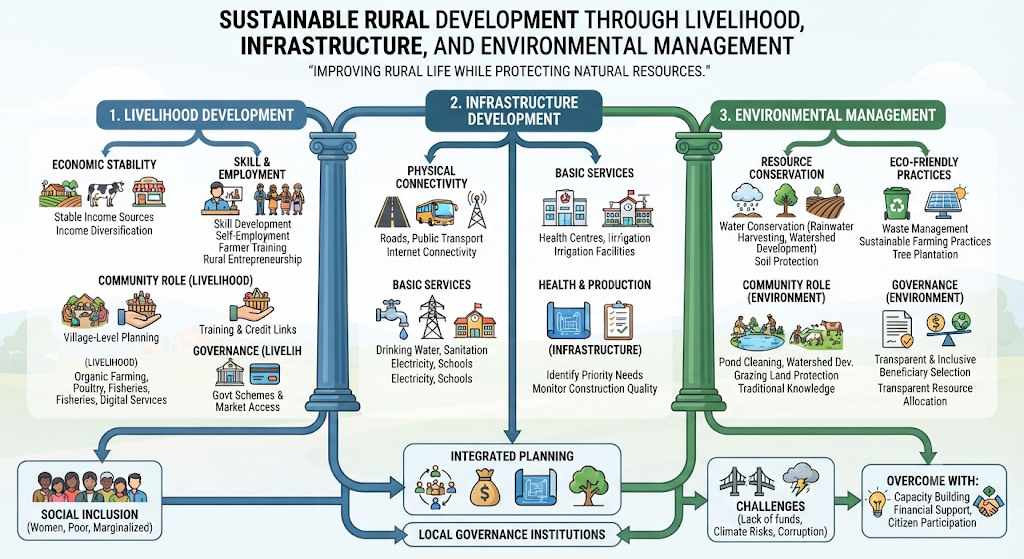
Community participation is important for livelihood development because local people understand their resources, skills and market needs. Village-level planning can identify suitable livelihood activities such as organic farming, poultry, tailoring, beekeeping, fisheries, handicrafts, digital services and agro-based enterprises. Local governance institutions can connect people with training, credit, government schemes and market linkages.
Infrastructure development is another important aspect of rural development. Roads, electricity, drinking water, sanitation, schools, health centres, internet connectivity, irrigation facilities and public transport directly affect quality of life. Good infrastructure improves education, healthcare, employment, mobility and market access. Local governance helps identify priority infrastructure needs and monitor construction quality.
Environmental management is essential for sustainable rural development. Rural communities are closely connected with land, water, forests and agriculture. Degradation of natural resources directly affects rural livelihoods. Water scarcity, soil erosion, deforestation, pollution and climate change can reduce agricultural productivity and increase poverty. Therefore, rural development must include water conservation, tree plantation, soil protection, waste management and sustainable farming practices.
Community participation is very useful in environmental management. Villagers can participate in pond cleaning, rainwater harvesting, watershed development, plantation drives, grazing land protection and waste management. Traditional local knowledge can support sustainable use of natural resources. When communities are involved, environmental projects are more likely to continue successfully.
Local governance institutions can integrate livelihood, infrastructure and environmental planning. For example, a Gram Panchayat can plan water conservation projects under rural employment schemes, improve irrigation for farmers and create local employment at the same time. Similarly, sanitation projects can improve health, environment and dignity.
Sustainable rural development also requires social inclusion. Livelihood and infrastructure benefits must reach women, poor families, landless workers and marginalized groups. If development benefits only dominant groups, rural inequality increases. Therefore, beneficiary selection and resource allocation must be transparent and inclusive.
Challenges in sustainable rural development include lack of funds, weak planning, corruption, climate risks, migration, poor technical support and limited community awareness. To overcome these challenges, local governance institutions need capacity building, financial support, technical guidance and active citizen participation.
Conclusion#
Community participation and local governance are fundamental pillars of sustainable rural development and social inclusion. Active involvement of rural citizens in planning, implementation, monitoring, and evaluation of development programmes ensures that local needs and priorities are effectively addressed. Participation transforms villagers from passive beneficiaries into active stakeholders, thereby strengthening ownership, transparency, accountability, and sustainability of development initiatives.
The study highlights that local governance institutions such as Gram Panchayats, Gram Sabhas, self-help groups, and community-based organizations play a significant role in decentralized planning, service delivery, livelihood generation, infrastructure development, and environmental management. These institutions also promote social inclusion by providing opportunities for women, Scheduled Castes, Scheduled Tribes, minorities, and other marginalized groups to participate in decision-making processes.
However, challenges such as inadequate awareness, social inequalities, political interference, limited financial resources, and weak institutional capacity continue to affect the effectiveness of local governance. Addressing these challenges through capacity building, awareness programmes, financial empowerment, transparency mechanisms, and inclusive participation is essential.
Thus, sustainable rural development and social inclusion can be achieved only when local communities actively participate in governance processes and development decisions. Strengthening community participation and grassroots governance can empower rural citizens, enhance democratic practices, reduce social exclusion, and contribute to building resilient, self-reliant, and sustainable rural societies.
Works Cited#
- Chambers, Robert. Rural Development: Putting the Last First. Longman, 1983.
- Chambers, Robert. Whose Reality Counts? Putting the First Last. Intermediate Technology Publications, 1997.
- Oakley, Peter. Projects with People: The Practice of Participation in Rural Development. International Labour Organization, 1991.
- Pretty, Jules N. “Participatory Learning for Sustainable Agriculture.” World Development, vol. 23, no. 8, 1995, pp. 1247–1263.
- Uphoff, Norman. Local Institutional Development: An Analytical Sourcebook with Cases. Kumarian Press, 1986.
- United Nations. Transforming Our World: The 2030 Agenda for Sustainable Development. United Nations, 2015.
- World Bank. World Development Report 2000/2001: Attacking Poverty. Oxford UP, 2001.
- World Bank. World Development Report 2022: Finance for an Equitable Recovery. World Bank, 2022.
- United Nations Development Programme. Human Development Report 2021/2022. UNDP, 2022.
- Agrawal, Arun, and Jesse C. Ribot. “Accountability in Decentralization.” Journal of Developing Areas, vol. 33, no. 4, 1999, pp. 473–502.
- Bardhan, Pranab, and Dilip Mookherjee. Decentralization and Local Governance in Developing Countries. MIT Press, 2006.
- Crook, Richard C., and James Manor. Democratic Decentralisation and Institutional Performance. Cambridge UP, 1998.
- Mansuri, Ghazala, and Vijayendra Rao. Localizing Development: Does Participation Work? World Bank, 2013.
- Putnam, Robert D. Making Democracy Work: Civic Traditions in Modern Italy. Princeton UP, 1993.
- Ostrom, Elinor. Governing the Commons: The Evolution of Institutions for Collective Action. Cambridge UP, 1990.
- Government of India. The Constitution (73rd Amendment) Act, 1992. Government of India, 1993.
- Mathew, George. Status of Panchayati Raj in the States and Union Territories of India. Institute of Social Sciences, 2000.
- Singh, Katar. Rural Development: Principles, Policies and Management. Sage Publications, 2009.
- Desai, Vasant. Rural Development in India. Himalaya Publishing House, 2017.
- Narayan, Deepa. Empowerment and Poverty Reduction: A Sourcebook. World Bank, 2002.
"Assessment of Psychological Well-being, Workplace Spirituality, and Job Satisfaction among Healthcare and