Abstract
The present study examines climate change awareness, environmental attitudes, and sustainable behaviour among citizens through a multidisciplinary perspective. Climate change has become one of the most serious global challenges, affecting health, agriculture, water resources, biodiversity, livelihood, and overall quality of life. The study explores citizens’ understanding of climate change causes, impacts, mitigation measures, and adaptation practices. It also analyses how environmental attitudes influence daily sustainable behaviours such as energy saving, water conservation, waste reduction, recycling, public transport use, tree plantation, and responsible consumption. The study highlights that awareness alone may not always lead to sustainable behaviour unless supported by positive attitudes, environmental education, community participation, policy support, and accessible green alternatives. The study concludes that improving climate literacy and promoting pro-environmental attitudes are essential for encouraging responsible citizen behaviour and achieving sustainable development.
- Climate Change Awareness
- Environmental Attitudes
- Sustainable Behaviour
- Citizens
- Environmental Education
- Sustainable Development
- Pro-Environmental Practices
Introduction#
Climate change is one of the most critical environmental, social, economic, and developmental challenges of contemporary society. It refers to long-term changes in temperature, rainfall patterns, sea level, weather events, and ecological conditions caused largely by human activities such as deforestation, industrialization, fossil fuel use, urbanization, and excessive consumption of natural resources. Climate change affects not only the natural environment but also human health, agriculture, water availability, food security, biodiversity, livelihood, migration, and social well-being.
In recent decades, climate change has become a major concern for governments, scientists, educators, communities, and citizens across the world. Rising temperatures, irregular rainfall, floods, droughts, heat waves, melting glaciers, forest fires, and air pollution have increased public concern regarding environmental protection. However, effective response to climate change depends not only on government policies and technological solutions but also on citizens’ awareness, attitudes, and everyday behaviour.
Climate change awareness refers to the knowledge and understanding of climate change, its causes, consequences, risks, and possible solutions. A climate-aware citizen understands how human actions contribute to environmental degradation and how responsible practices can reduce harmful impacts. Awareness helps individuals recognize the importance of energy conservation, water saving, waste management, tree plantation, sustainable transport, and responsible consumption. Without adequate awareness, citizens may fail to understand the seriousness of climate change and may continue unsustainable practices.
Environmental attitude is another important factor influencing climate-related behaviour. It refers to an individual’s beliefs, feelings, values, and concern toward the environment. A positive environmental attitude encourages people to protect nature, conserve resources, reduce pollution, and support sustainable policies. Citizens with strong environmental concern are more likely to adopt eco-friendly practices in daily life. However, environmental attitudes may be influenced by education, income, culture, media exposure, community values, government initiatives, and personal experience of environmental problems.
Sustainable behaviour refers to actions that reduce environmental harm and support long-term ecological balance. It includes using less electricity, saving water, avoiding plastic, recycling waste, using public transport, planting trees, reducing food waste, purchasing eco-friendly products, and supporting environmental campaigns. Sustainable behaviour is essential because climate change cannot be addressed only through large-scale policies; individual and community actions also play a significant role. A multidisciplinary study of climate change awareness, environmental attitudes, and sustainable behaviour is important because climate change is not only a scientific issue. It is connected with sociology, economics, psychology, education, political science, public health, agriculture, urban planning, and environmental studies. Psychology helps explain why people adopt or avoid sustainable behaviour. Sociology examines community norms and social practices. Economics studies consumption patterns and green choices. Education promotes climate literacy. Public policy creates rules and incentives for environmental protection.
Climate Change Awareness and Environmental Literacy among Citizens#
Climate change awareness is the basic understanding that citizens have about climate change, its causes, effects and possible solutions. It includes knowledge about rising temperature, changing rainfall patterns, floods, droughts, heat waves, melting glaciers, sea-level rise, air pollution, deforestation and loss of biodiversity. In contemporary society, climate change awareness has become essential because environmental problems directly affect human health, agriculture, livelihood, water availability and quality of life.
Environmental literacy is broader than simple awareness. It means the ability to understand environmental issues, evaluate their causes, recognize human responsibility and take informed action for environmental protection. An environmentally literate citizen understands that climate change is not only a natural process but is largely accelerated by human activities such as burning fossil fuels, excessive use of vehicles, industrial pollution, deforestation, overconsumption, plastic use and unsustainable development.
Citizens with higher climate change awareness are more likely to understand the seriousness of environmental degradation. They can identify the connection between daily activities and climate impact. For example, excessive electricity use increases energy demand, private vehicle use increases carbon emissions, and plastic waste contributes to pollution. Such awareness encourages people to adopt responsible habits like saving electricity, using public transport, reducing waste and planting trees.
Climate change awareness is influenced by education, media exposure, personal experience, government campaigns, community participation and access to information. Citizens who experience floods, water shortage, extreme heat or air pollution may become more sensitive to climate change. Schools, colleges, newspapers, television, social media and environmental campaigns also play an important role in spreading climate-related knowledge.
However, awareness is not always equal in all sections of society. Urban citizens may have more exposure to environmental information, while rural citizens may experience climate impacts directly through agriculture and water problems. Similarly, educated citizens may understand scientific causes of climate change better, whereas others may connect environmental changes with local experiences. Therefore, environmental education should be simple, practical and accessible to all citizens.
Environmental literacy helps citizens move from knowledge to action. It develops critical thinking, responsible decision-making and participation in environmental protection. A literate citizen not only understands climate change but also questions harmful practices, supports green policies and participates in sustainable activities. Thus, climate change awareness and environmental literacy are important foundations for sustainable behaviour and responsible citizenship.
Environmental Attitudes, Values, and Public Concern toward Climate Change#
Environmental attitude refers to the feelings, beliefs and opinions that individuals hold toward nature, environmental protection and climate change. It shows whether citizens consider environmental issues important and whether they feel responsible for protecting natural resources. A positive environmental attitude encourages people to conserve water, reduce pollution, avoid waste and support climate-friendly practices.
Environmental values are the deeper principles that guide human behaviour toward nature. Some citizens value the environment because it supports human life, while others respect nature for its own existence. Values such as responsibility, simplicity, conservation, respect for biodiversity and concern for future generations are important for sustainable living. When people believe that nature must be protected for present and future generations, they are more likely to adopt eco-friendly behaviour.
Public concern toward climate change has increased in recent years due to visible environmental changes. Rising temperatures, poor air quality, irregular rainfall, floods, droughts and health problems have made citizens more aware of climate risks. Public concern is important because it creates pressure on governments, industries and communities to take action. Citizens who are concerned about climate change may support renewable energy, waste management, tree plantation, public transport and stricter pollution control.
However, environmental attitude does not always lead to sustainable behaviour. Many people express concern about climate change but continue unsustainable habits due to convenience, lack of alternatives, cost, social habits or low motivation. For example, a person may support pollution control but still use private vehicles daily due to poor public transport. Therefore, positive attitude must be supported by practical facilities and policy support.
Environmental attitudes are shaped by family, education, culture, religion, media, peer groups and personal experiences. Children who grow up in families that save water, plant trees and avoid waste often develop positive environmental values. Schools and colleges can strengthen these values through environmental education, nature visits, cleanliness drives and sustainability projects.
Public concern can also be strengthened through awareness campaigns, documentaries, community meetings, social media messages and local environmental activities. When citizens understand that climate change affects food, health, water and livelihood, their concern becomes stronger. Thus, environmental attitudes and values play a major role in motivating citizens toward sustainable lifestyles.
Sustainable Behaviour and Everyday Eco-Friendly Practices#
Sustainable behaviour refers to daily actions that reduce environmental harm and support long-term ecological balance. It includes responsible use of natural resources, reduction of waste, conservation of energy and adoption of eco-friendly habits. Climate change cannot be controlled only through government policies; citizens’ everyday behaviour also plays a very important role.
Common sustainable behaviours include switching off lights and fans when not in use, saving water, using public transport, walking or cycling for short distances, avoiding single-use plastic, recycling waste, composting kitchen waste, planting trees and using energy-efficient appliances. These small actions may appear simple, but when practised collectively by large numbers of citizens, they can create significant environmental benefits.
Responsible consumption is an important part of sustainable behaviour. Citizens should avoid unnecessary purchasing, reduce food waste, choose durable products and prefer eco-friendly goods. Overconsumption increases pressure on natural resources and produces more waste. Sustainable behaviour encourages people to live with balance and avoid wasteful lifestyles.
Waste management is another important area. Citizens can separate dry and wet waste, recycle paper, glass and plastic, and compost organic waste. Improper waste disposal causes land pollution, water pollution and health hazards. Sustainable waste practices reduce pollution and support cleaner communities.
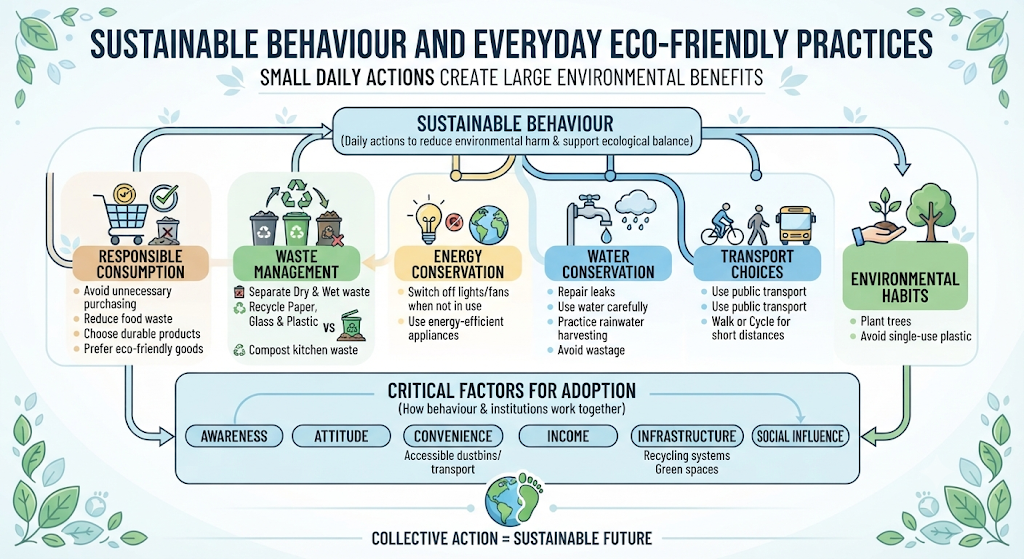
Water conservation is also essential, especially in areas facing water scarcity. Citizens can save water by repairing leaks, using water carefully, harvesting rainwater and avoiding wastage during daily activities. Similarly, energy conservation reduces carbon emissions and supports climate protection.
Sustainable behaviour depends on awareness, attitude, convenience, income, infrastructure and social influence. People are more likely to follow eco-friendly practices when facilities are available, such as dustbins, recycling systems, public transport, clean energy options and green public spaces. Therefore, individual behaviour and institutional support must work together.
Role of Education, Policy, and Community Participation in Climate Action#
Education plays a central role in promoting climate change awareness and sustainable behaviour. Environmental education helps citizens understand the causes and effects of climate change and teaches them how to protect natural resources. Schools, colleges and universities can develop climate awareness through classroom teaching, projects, debates, poster-making, field visits, tree plantation drives and waste management activities. Education should not be limited to theory. It must encourage practical behaviour such as saving water, reducing plastic use, conserving energy and maintaining cleanliness. Students can become climate ambassadors in their families and communities by spreading awareness and practising sustainable habits. Government policy is equally important in climate action. Policies related to renewable energy, pollution control, public transport, waste management, forest conservation, water protection and sustainable agriculture can guide society toward environmental responsibility. Without proper policy support, individual efforts may remain limited. For example, citizens may want to recycle waste, but recycling systems must be available. Policy can also encourage sustainable behaviour through incentives and regulations. Subsidies for solar energy, promotion of electric vehicles, bans on single-use plastic, strict pollution rules and support for rainwater harvesting can promote climate-friendly practices.
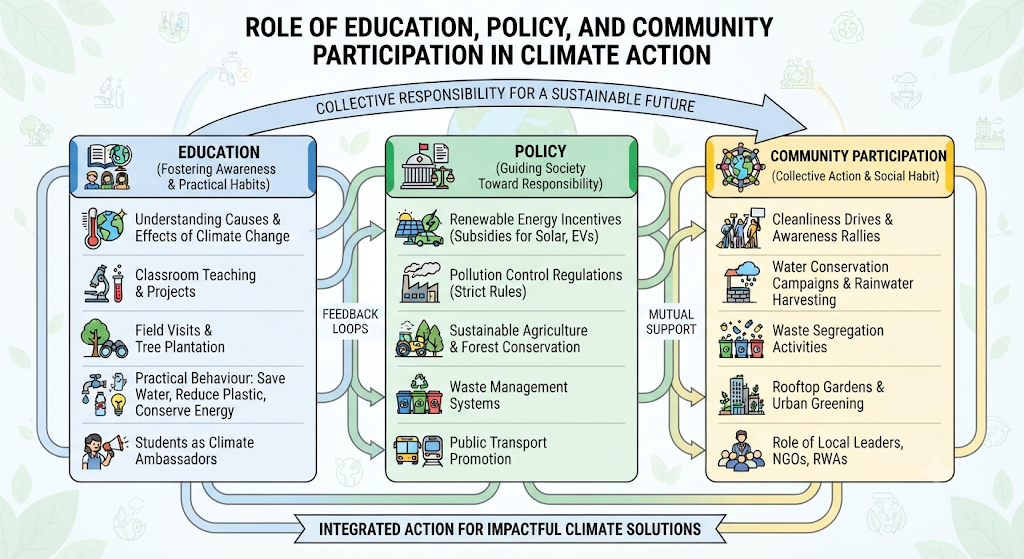
Government campaigns can also increase awareness among citizens.
Community participation is necessary because climate action is a collective responsibility. Local communities can organize cleanliness drives, plantation programmes, awareness rallies, water conservation campaigns and waste segregation activities. When people work together, sustainable behaviour becomes a social habit rather than an individual effort. Community-based climate action is especially useful in rural and urban local areas. Rural communities can focus on water conservation, sustainable farming and forest protection. Urban communities can work on waste management, public transport use, rooftop gardens and pollution reduction. Local leadership, NGOs, schools, resident welfare associations and youth groups can play an important role.
Conclusion#
Climate change awareness, environmental attitudes and sustainable behaviour are closely connected with responsible citizenship and sustainable development. Awareness helps citizens understand the causes, effects and seriousness of climate change, while positive environmental attitudes develop concern, responsibility and respect for nature.
The study highlights that sustainable behaviour, such as saving water, conserving energy, reducing plastic use, recycling waste, using public transport and planting trees, is necessary for reducing environmental harm. However, awareness alone is not enough; education, policy support, green infrastructure and community participation are also required.
Thus, climate action must involve citizens, educational institutions, government agencies and communities together. Promoting environmental literacy and eco-friendly habits can help build a cleaner, healthier and more sustainable society for present and future generations.
Works Cited#
- Intergovernmental Panel on Climate Change. Climate Change 2021: The Physical Science Basis. Cambridge UP, 2021.
- Intergovernmental Panel on Climate Change. Climate Change 2022: Impacts, Adaptation and Vulnerability. Cambridge UP, 2022.
- United Nations. Transforming Our World: The 2030 Agenda for Sustainable Development. United Nations, 2015.
- United Nations Environment Programme. Emissions Gap Report 2022. UNEP, 2022.
- UNESCO. Education for Sustainable Development Goals: Learning Objectives. UNESCO, 2017.
- UNESCO. Education for Sustainable Development: A Roadmap. UNESCO, 2020.
- Stern, Nicholas. The Economics of Climate Change: The Stern Review. Cambridge UP, 2007.
- Gifford, Robert. “The Dragons of Inaction: Psychological Barriers That Limit Climate Change Mitigation and Adaptation.” American Psychologist, vol. 66, no. 4, 2011, pp. 290–302.
- Kollmuss, Anja, and Julian Agyeman. “Mind the Gap: Why Do People Act Environmentally and What Are the Barriers to Pro-Environmental Behavior?” Environmental Education Research, vol. 8, no. 3, 2002, pp. 239–260.
- Dunlap, Riley E., et al. “Measuring Endorsement of the New Ecological Paradigm.” Journal of Social Issues, vol. 56, no. 3, 2000, pp. 425–442.
- Stern, Paul C. “Toward a Coherent Theory of Environmentally Significant Behavior.” Journal of Social Issues, vol. 56, no. 3, 2000, pp. 407–424.
- Ajzen, Icek. “The Theory of Planned Behavior.” Organizational Behavior and Human Decision Processes, vol. 50, no. 2, 1991, pp. 179–211.
- Hungerford, Harold R., and Trudi L. Volk. “Changing Learner Behavior through Environmental Education.” Journal of Environmental Education, vol. 21, no. 3, 1990, pp. 8–21.
- Clayton, Susan, and Gene Myers. Conservation Psychology: Understanding and Promoting Human Care for Nature. Wiley-Blackwell, 2015.
- Leiserowitz, Anthony. “Climate Change Risk Perception and Policy Preferences.” Climatic Change, vol. 77, 2006, pp. 45–72.
- O’Neill, Saffron, and Sophie Nicholson-Cole. “Fear Won’t Do It.” Science Communication, vol. 30, no. 3, 2009, pp. 355–379.
- Whitmarsh, Lorraine. “Behavioural Responses to Climate Change.” Journal of Environmental Psychology, vol. 29, no. 1, 2009, pp. 13–23.
- Steg, Linda, and Charles Vlek. “Encouraging Pro-Environmental Behaviour.” Journal of Environmental Psychology, vol. 29, no. 3, 2009, pp. 309–317.
- United Nations Framework Convention on Climate Change. The Paris Agreement. UNFCCC, 2015.
- World Bank. World Development Report 2010: Development and Climate Change. World Bank, 2010.